温阳化气法对呼吸衰竭机械通气老年患者治疗后中医症状、血气分析以及脱机时间的影响
2021-01-06 23:42:17张龙海
中国典型病例大全
2021年14期
张龙海
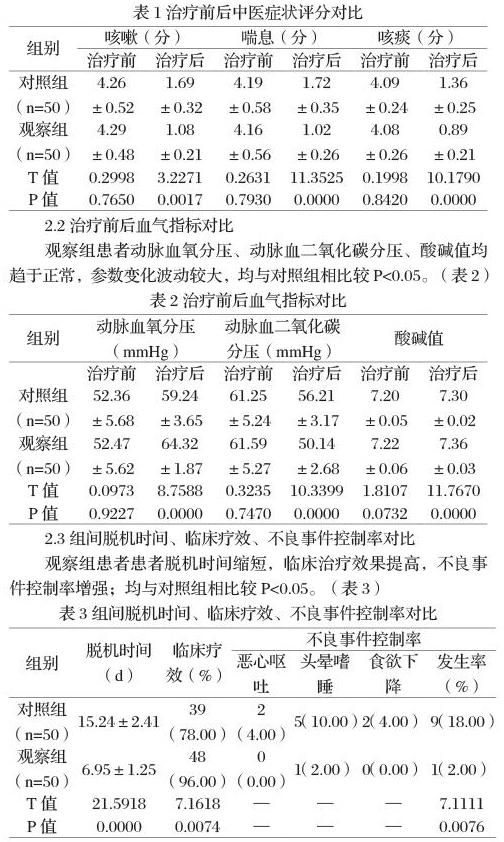
摘要:目的:探究呼吸衰竭机械通气老年患者采用温阳化气法后患者中医症状、血气分析以及脱机时间的变化情况。方法:以100位呼吸衰竭疾病患者开展研究,均分对照组(常规治疗)、观察组(温阳化气法治疗);以中医症状、血气分析以及脱机时间、不良事件等参数评估。结果:观察组患者中医症状评分降低,症状得到改善;且动脉血氧分压、动脉血二氧化碳分压、酸碱值均趋于正常,参数变化波动较大;患者脱机时间缩短,临床治疗效果提高,不良时间控制率增强;均与对照组相比较P<0.05。结论:为经机械通气治疗的呼吸衰竭患者采用温阳化气法治疗,可实现对患者病情的进一步控制,改善患者的临床症状,调节血气指标,缓解呼吸衰竭造成的不适感,加快患者脱机时间,控制患者不良事件,值得广泛推广温阳化气法临床治疗呼吸衰竭。
关键词:温阳化气法;呼吸衰竭;机械通气;老年;中医症状;血气分析;脱机时间
Effect of Yang-Hua-Qi method on TCM symptoms, blood gas analysis and offline time of elderly patients with respiratory failure after mechanical ventilation treatment 【 Abstract 】 Objective: To explore the changes of TCM symptoms, blood gas analysis and off-line time of elderly patients with respiratory failure after adopting the method of warming yang and transforming qi. Methods: 100 patients with respiratory failure were divided into control group (routine treatment) and observation group (warming yang and transforming qi therapy). It was evaluated by TCM symptoms, blood gas analysis, offline time, adverse events and other parameters. Results: The scores of TCM symptoms in the observation group decreased and the symptoms were improved. And arterial oxygen partial pressure, arterial carbon dioxide partial pressure and pH value all tend to be normal, and the parameter changes fluctuate greatly. Patients' offline time is shortened, clinical treatment effect is improved, and bad time control rate is enhanced. Compared with the control group, P<0.05. Conclusion: For patients with respiratory failure treated by mechanical ventilation, the method of warming yang and transforming qi can further control the patients' condition, improve their clinical symptoms, adjust blood gas indexes, relieve the discomfort caused by respiratory failure, speed up patients' offline time, and control patients' adverse events, which is worthy of extensive promotion in clinical treatment of respiratory failure.
[Keywords:]: warming yang and transforming qi method; Respiratory failure; Mechanical ventilation; Old age; TCM symptoms; Blood gas analysis; Offline time
【中图分类号】R28 【文献标识码】A 【文章编号】1673-9026(2021)14--02
引言
呼吸衰竭的原发病不同,具有较大的差异,发病机制为人体换气严重障碍,身体无法自主完成气体交换,诱使患者出现缺氧、二氧化碳潴留等,进而导致患者出现代谢过程紊乱情况[1]。呼吸衰竭临床症状主要表现为呼吸困难,呼吸频率发生变化、发绀等,且患者精神状态受到影响,缺氧状态的持续,使得患者心率增加,血压上升,加剧心律失常发生的风险性,患者肝功能异常、电解质紊乱,严重影响患者的血气指标参数[2]。……
登录APP查看全文
猜你喜欢
现代仪器与医疗(2016年6期)2017-01-12 18:14:34
中国实用医药(2016年24期)2016-10-17 06:10:10
中国实用医药(2016年24期)2016-10-17 05:53:10
中国实用医药(2016年24期)2016-10-17 05:39:30
中国实用医药(2016年24期)2016-10-17 05:15:48
中国实用医药(2016年24期)2016-10-17 04:26:41
中国实用医药(2016年17期)2016-07-26 23:24:25
饮食与健康·下旬刊(2016年7期)2016-05-10 13:07:44
中国当代医药(2015年2期)2015-03-11 17:49:13