
土壤基质调理剂对障碍土壤改良及叶菜生长的影响
2021-03-01 11:14:16周冉冉郭世荣蔡忠
安徽农业科学
2021年3期
周冉冉 郭世荣 蔡忠
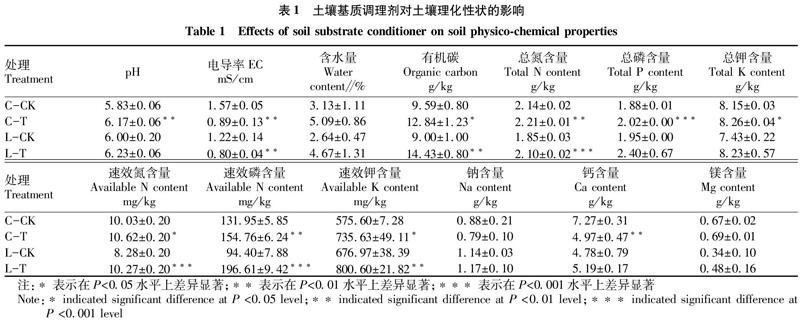


摘要 [目的]有效利用有機废弃物资源并解决设施障碍土壤的酸化、盐渍化等问题。[方法]将醋糟和菇渣生物基质按体积3∶1混合形成土壤基质调理剂,施用390 m3/hm2与耕作层土壤混匀后,种植小白菜和生菜。[结果]土壤基质调理剂使用后种植小白菜和生菜的土壤pH分别增加提高0.34和0.23,EC分别降低0.68和0.42 mS/cm,有机碳含量分别增加3.25和5.43 g/kg,速效氮含量分别增加0.59和1.99 mg/kg,速效磷含量分别增加22.81和102.21 mg/kg,速效钾含量分别增加178.03和123.63 mg/kg。基质调理剂有效地缓解了设施障碍土壤酸化和盐渍化,且提高了土壤养分含量和酶活性。与对照相比,种植小白菜和生菜分别增产5.49%和19.35%。[结论]醋糟和菇渣生物基质调理剂(3∶1体积比混合)可改良障碍土壤、显著促进叶菜生长。
关键词 基质调理剂;酸化盐渍化;设施栽培;叶菜;土壤改良
中图分类号 S156.99;S626.9 文献标识码 A 文章编号 0517-6611(2021)03-0160-05
doi:10.3969/j.issn.0517-6611.2021.03.044
Abstract [Objective]To effectively use organic residues resources and solve the problem of acidification and salinization of facility obstacle soil. [Method]Vinegar substrate and mushroom residues substrate were mixed in 3∶1 volume to form a soil substrate conditioner. Chinese cabbage and lettuce were grown after application of 390 m3/hm2 substrate conditioner to mix with the soil of the tillage layer. [Result]After using the soil substrate conditioner, the soil pH of cabbage and lettuce plants increased by 0.34 and 0.23, EC decreased by 0.68 and 0.42 mS/cm, and the organic carbon content increased by 3.25 and 5.43 g/kg, respectively. The available nitrogen content increased by 0.59 and 1.99 mg/kg, the available phosphorus content increased by 22.81 and 102.21 mg/kg, and the available potassium content increased by 178.03 and 123.63 mg/kg, respectively. The substrate conditioner effectively relieved the acidification and salinization of the facility soil and increased the soil nutrient content and soil enzyme activity. Compared with the control, yield of cabbage and lettuce increased by 5.49% and 19.35%, respectively. [Conclusion]Vinegar and mushroom residue substrate conditioner (3∶1 volume ratio mixing) can improve the obstacle soil and significantly promote the growth of leafy vegetable.
Key words Substrate conditioner;Acidification and salinization;Facility cultivation;Leafy vegetable;Soil improvement
21世纪以来,我国设施园艺发展迅猛,成为世界上设施面积最大的国家,占全世界85%以上[1]。同时,设施蔬菜生产占世界总收获面积的45%,在我国经济中占有重要地位[2]。设施蔬菜生产是农业集约化生产的形式之一,由于市场的需求和经济的刺激,给农民带来可观的经济收入。但由于封闭的温室环境加之不合理的水肥管理措施以及长期连续不断作物种植,设施土壤出现了酸化、次生盐渍化、营养元素失衡等障碍问题。同时,设施栽培中连年的作物种植也导致设施土壤中有毒物质积累、土壤酶活性降低、微生物区系紊乱,最终导致作物减产,品质下降[3-4]。……
登录APP查看全文
