关节镜下双排缝合与缝线桥技术治疗肩袖撕裂的临床效果比较
2021-03-24 08:00:33刘成日刘彦群李成福张保健李海锋
中国医学创新
2021年16期
刘成日 刘彦群 李成福 张保健 李海锋
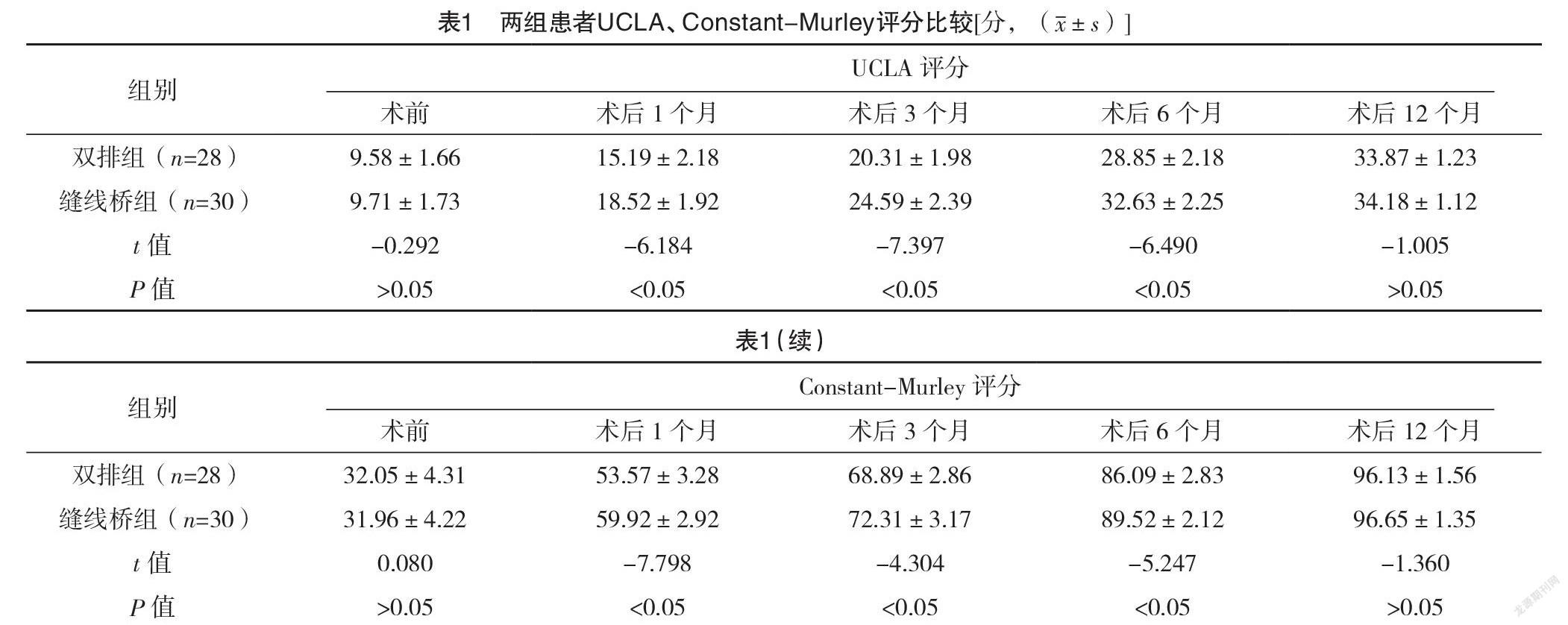
【摘要】 目的:比较关节镜下双排缝合与缝线桥技术治疗肩袖撕裂的临床效果。方法:回顾性分析2018年5月-2019年10月在本院行关节镜下修复治疗的58例肩袖撕裂患者的临床资料,依据手术方式的不同将其分为双排组28例和缝线桥组30例。术后所有患者均给予指导性功能锻炼。记录并比较两组术后并发症发生情况及术前及术后1、3、6、12个月UCLA和Constant-Murley肩关节评分。结果:58例患者随访12~15个月,平均13.8个月。术前,两组UCLA和Constant-Murley评分比较,差异均无统计学意义(P>0.05)。術后1、3、6个月,两组患者UCLA和Constant-Murley评分均高于术前,且缝线桥组高于双排组,差异均有统计学意义(P<0.05)。术后12个月,两组UCLA和Constant-Murley评分比较,差异无统计学意义(P>0.05)。术后3个月内,两组未出现感染、锚钉拔出、关节僵硬等并发症。复查MRI显示,双排组再撕裂2例,发生率7.14%;缝线桥组再撕裂1例,发生率3.33%。两组再撕裂发生率比较,差异无统计学意义(字2=0.429,P>0.05)。术后6个月时复查MRI显示肩袖愈合良好,未发生再撕裂。结论:关节镜下双排缝合与缝线桥技术治疗肩袖撕裂均能取得良好疗效,而缝线桥技术的疗效优于双排缝合技术,有利于腱-骨愈合和早期康复,能有效促进肩关节功能恢复。
【关键词】 关节镜 肩袖撕裂 双排 缝线桥
Clinical Efficacy Comparison of Double-row Suture and Suture Bridge Technique for Treatment of Rotator Cuff Tear under Arthroscopy/LIU Chengri, LIU Yanqun, LI Chengfu, ZHANG Baojian, LI Haifeng. //Medical Innovation of China, 2021, 18(16): 0-042
[Abstract] Objective: To compare the clinical efficacy of double-row suture and suture bridge technique for treatment of rotator cuff tear under arthroscopy. Method: The clinical data of 58 patients with rotator cuff tear who underwent arthroscopic repair treatment in our hospital from May 2018 to October 2019 were retrospectively analyzed, and they were divided into double row group (28 cases) and suture bridge group (30 cases) according to different surgical methods. All patients were given instructive functional exercise after surgery. The incidence of complications after surgery of both groups were compared, and UCLA and Constant-Murley shoulder scores of both groups were compared before surgery and 1, 3, 6, and 12 months after surgery. Result: Finally 58 patients were followed up for 12-15 months successfully, averaging 13.8 months. Before surgery, there were no significant differences in UCLA and Constant-Murley scores between two groups (P>0.05). At 1, 3 and 6 months after surgery, UCLA and Constant-Murley scores of both groups were higher than those before surgery, and those of suture bridge group were higher than those of double row group, with statistical significance (P<0.05). 12 months after surgery, there were no significant differences in UCLA and Constant-Murley scores between two groups (P>0.05). No infection, anchor pullout, joint stiffness and other complications occurred in two groups within 3 months after surgery. Reexamination MRI showed that there were two cases of retear in the double-row group, the incidence was 7.14%; there was one cases of retear in suture bridge group, the incidence was 3.33%, there was no significant difference in the incidence of retear between two groups (字2=0.429, P>0.05). At 6 months after surgery, MRI reexamination showed that the rotator cuff healed well without retearing. Conclusion: Both double-row suture and suture bridge technique under arthroscopy can achieve good efficacy in the treatment of rotator cuff tear, but suture bridge technique is better efficacy than double-row suture technique, which is beneficial to tendon-bone healing and early rehabilitation, and can effectively promote the functional recovery of shoulder joint.
[Key words] Arthroscopy Rotator cuff tears Double-row Suture bridge
First-author’s address: Yanbian University Hospital(Yanbian Hospital), Yanji 133000, China
doi:10.3969/j.issn.1674-4985.2021.16.009
肩袖撕裂是导致肩关节疼痛与功能障碍的重要因素,严重者会影响工作睡眠等生活质量[1]。目前,关节镜下微创治疗肩袖撕裂已成为主要术式[2-3],常用的缝合固定方法包括单排固定、双排固定和缝线桥固定等[4]。其中双排缝合技术在覆盖面积及固定强度等生物力学方面较单排缝合技术更具优势,并在临床实践中取得满意效果。……
登录APP查看全文