
营口地区8~10岁儿童碘营养状况及影响因素分析
2021-03-27 02:31:53杨珊珊
中国医学创新
2021年26期
杨珊珊
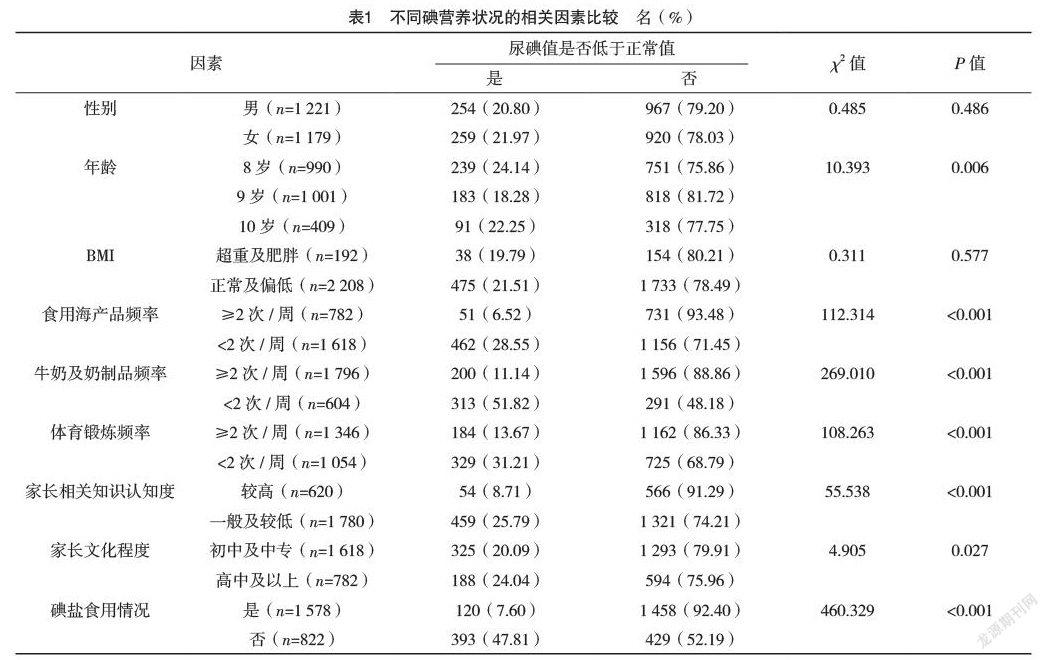
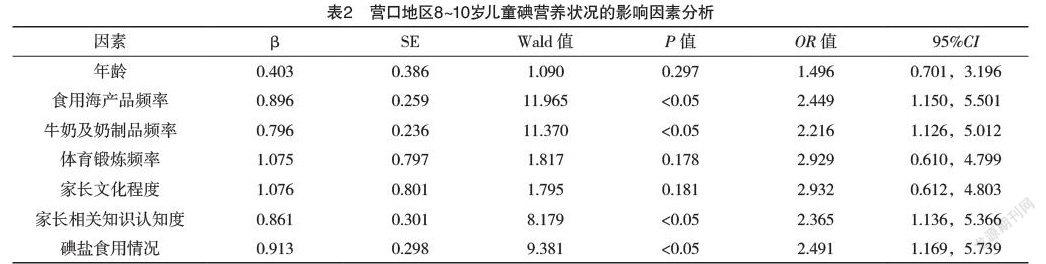
【摘要】 目的:探究與分析营口地区8~10岁儿童碘营养状况及影响因素。方法:选取营口地区2018年12月-2020年12月的2 400名8~10岁儿童为研究对象,统计尿碘值低于正常值的发生情况。比较不同性别、年龄、BMI、食用海产品频率、牛奶及奶制品频率、体育锻炼频率、家长相关知识认知度、家长文化程度及碘盐食用情况者的尿碘值低于正常值的发生率,分析儿童碘营养状况的影响因素。结果:2 400名8~10岁儿童中,有513名尿碘值低于正常值,发生率为21.38%。不同性别、BMI者的碘营养状况比较,差异无统计学意义(P>0.05),不同年龄、食用海产品频率、牛奶及奶制品频率、体育锻炼频率、家长相关知识认知度、家长文化程度及碘盐食用情况者的碘营养状况比较,差异均有统计学意义(P<0.05)。多因素logistic回归分析显示,食用海产品频率、牛奶及奶制品频率、家长相关知识认知度及碘盐食用情况对营口地区8~10岁儿童碘营养状况有一定的影响(P<0.05)。结论:营口地区8~10岁儿童碘营养情况的影响因素涉及食用海产品频率、牛奶及奶制品频率、家长相关知识认知度及碘盐食用情况,应重视对上述因素的评估与干预。
【关键词】 营口地区 8~10岁 碘营养
[Abstract] Objective: To explore and analyze iodine nutrition status and influencing factors of children aged 8 to 10 years in Yingkou area. Method: A total of 2 400 children aged 8 to 10 from December 2018 to December 2020 in Yingkou area were selected as subjects. The incidence of urinary iodine below normal value was analyzed. The incidence of urinary iodine below normal value was compared among different gender, age, BMI, frequency of seafood consumption, frequency of milk and dairy products, frequency of physical exercise, awareness of relevant knowledge of parents, educational level of parents and consumption of iodized salt, and the influencing factors of iodine nutritional status of children were analyzed. Result: Among 2 400 children aged 8 to 10, 513 children had lower urinary iodine value than normal value, the incidence rate was 21.38%. There were no significant differences in iodine nutrition status among different genders, BMI values (P>0.05). There were statistically significant differences in iodine nutritional status among different ages, frequency of seafood consumption, physical exercise frequency, frequency of milk and dairy products consumption, parents knowledge awareness, parents cultural background and iodized salt consumption (P<0.05). Multivariate logistic regression analysis showed that, the frequency of seafood consumption, the frequency of milk and dairy products consumption, parents knowledge awareness and iodized salt consumption had certain effects on iodine nutrition status of children aged 8 to 10 in Yingkou area (P<0.05). Conclusion: The influencing factors of iodine nutrition of children aged 8 to 10 in Yingkou area involve frequency of seafood consumption, frequency of milk and dairy products, parents awareness of relevant knowledge and consumption of iodized salt, and the evaluation and intervention of these factors should be emphasized.
[Key words] Yingkou area Aged 8 to 10 Iodine nutrition
First-authors address: Yingkou Center for Disease Control and Prevention, Yingkou 115000, China
doi:10.3969/j.issn.1674-4985.2021.26.042
碘作为机体的必须元素,其在甲状腺功能调节及某些组织代谢中均发挥着重要的作用,而8~10岁作为生长发育的重要阶段,碘缺乏对其影响更为突出,因此对本阶段儿童进行碘营养状况的评估与干预、改善需求较高[1-2]。地方病防治工作中与儿童碘营养状态及影响因素相关的研究均多见[3-5],但是研究涉及面均有待进一步扩宽,且现存的研究因素中关于儿童自身因素及家长因素的研究均有所不足,因此本方面的探究需求较高。……
登录APP查看全文
猜你喜欢
中老年保健(2022年5期)2022-08-24 02:36:04
当代陕西(2021年12期)2021-08-05 07:45:46
民用飞机设计与研究(2020年4期)2021-01-21 09:15:02
电子制作(2018年18期)2018-11-14 01:48:24
山东工业技术(2016年15期)2016-12-01 05:31:22
杂文选刊(2016年7期)2016-08-02 08:39:56
冰雪运动(2016年4期)2016-04-16 05:54:56
剑南文学(2015年1期)2015-02-28 01:15:15
记者观察(2010年9期)2010-12-31 00:00:00
小学生·新读写(2006年6期)2006-06-14 05:16:24
