规范化管理配合全程管理在肺癌免疫检查点抑制剂治疗中的管理效果及对依从性的影响
2021-04-02 03:38:38郑秋红邵秋月龚磊
中国现代医生
2021年5期
关键词:肺癌
郑秋红 邵秋月 龚磊

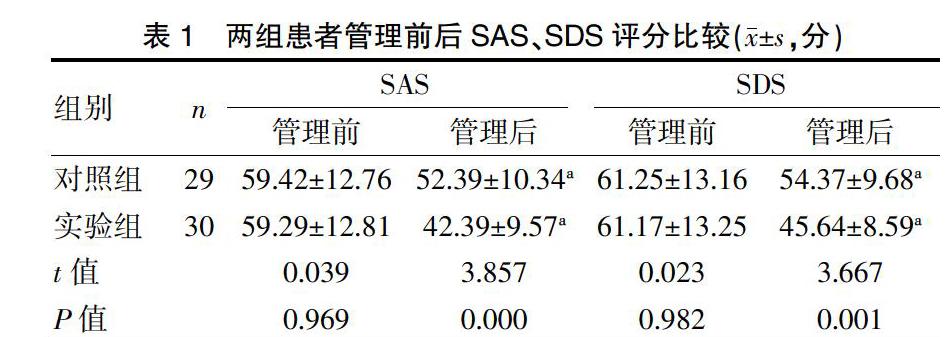
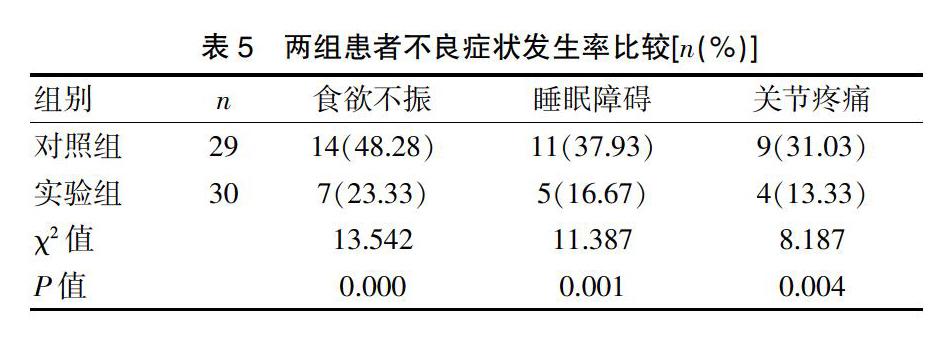
[摘要] 目的 分析在肺癌免疫检查点抑制剂治疗患者中应用规范化管理配合全程管理的效果以及对依从性的影响。 方法 将2019年1—12月在我院接受免疫治疗的59例肺癌患者纳入研究,并随机设为两个组别,给予对照组(29例)常规护理管理,给予实验组(30例)规范化管理配合全程管理。观察两组患者管理后的心理状况和治疗依从性,评价患者自我管理效能和生活质量,记录不良症状发生情况。 结果 实验组管理后SAS、SDS评分均低于对照组,差异具有统计学意义(P<0.05)。实验组管理后自我管理效能评分和治疗依从性评分均高于对照组,差异有统计学意义(P<0.05)。在生活质量各项评分中,实验组均低于对照组,差异有统计学意义(P<0.05)。对比两组患者不良反应发生率,实验组明显更低,差异有统计学意义(P<0.05)。 结论 规范化管理配合全程管理应用于肺癌免疫治疗患者中,能够有效缓解负性心理,提高自我管理能力和治疗依从性,降低不良症状发生率,改善生活质量,应用价值明显。
[关键词] 肺癌;免疫检查点抑制剂;规范化管理;全程管理;依从性
[Abstract] Objective To analyze the effect of standardized management combined with whole-course management and its impact on compliance in the treatment of patients with lung cancer immune checkpoint inhibitors. Methods Fifty-nine lung cancer patients who received immunotherapy in our hospital from January to December 2019 were included in the study, and were randomly divided into two groups. The control group(29 cases) was given routine care management and the experimental group(30 cases) was given standardized management cooperating with the whole process management. The psychological status and treatment compliance of the two groups after management was observed. The self-management efficiency and quality of life of the patients was evaluated, and the occurrence of adverse symptoms was recorded. Results The SAS and SDS scores of the experimental group were lower than those of the control group, and the difference was statistically significant(P<0.05). The self-management efficiency score and treatment compliance score of the experimental group after management were higher than those of the control group, and the difference was statistically significant(P<0.05). The scores of quality of life in the experimental group were lower than those of the control group, and the difference was statistically significant(P<0.05). The incidence of adverse reactions in the experimental group was significantly lower, and the difference was statistically significant(P<0.05). Conclusion Standardized management combined with full-course management in lung cancer immunotherapy patients can effectively relieve negative psychology, improve self-management ability and treatment compliance, reduce the incidence of adverse symptoms, improve the quality of life, and has obvious application value.
[Key words] Lung cancer; Immune checkpoint inhibitors; Standardized management; Whole process management; Compliance
肺癌是癌癥常见的重要死亡因素之一,死亡率占癌症总死亡人数的18.4%,严重威胁着人们的健康[1]。近年来随着社会的发展,我国肺癌发病人数逐渐增多,给家庭和社会带来极大负担[2]。尽管目前肺癌的治疗技术得到重大进展,但晚期肺癌生存率仍然较低。免疫治疗作为肺癌近年来新兴的治疗手段,对改善病情具有重要帮助[3]。其中抗程序细胞死亡蛋白Ⅰ(Programmed death-1,PD-1)及配体(PD-1 ligand,PD-L1)免疫检查点抑制剂在各项临床试验成功应用,在肿瘤治疗中取得了突破性进展,为包括鳞癌、腺癌和小细胞肺癌在内的多种病理类型肺癌患者均带来了临床获益[4-5]。但肺癌患者由于普遍合并其他并发症,长期承受病痛的折磨以及住院时间长、治疗效果不理想等因素的影响,治疗依从性不高,自我管理能力不足[6]。因此加强肺癌患者的管理,对提高治疗依从性、保证治疗效果具有重要意义。……
登录APP查看全文
猜你喜欢
保健医苑(2023年2期)2023-03-15 09:03:04
中国临床医学影像杂志(2022年2期)2022-05-25 13:24:34
中国药学药品知识仓库(2022年1期)2022-03-23 04:16:57
昆明医科大学学报(2021年4期)2021-07-23 01:21:44
天津医科大学学报(2021年2期)2021-03-29 05:30:38
天津医科大学学报(2019年6期)2019-08-13 07:04:26
癌变·畸变·突变(2016年3期)2016-02-27 06:15:34
医学研究杂志(2015年12期)2015-06-10 06:57:46
中国当代医药(2015年7期)2015-03-01 02:01:19
郑州大学学报(医学版)(2015年1期)2015-02-27 14:50:26