
基于trnH-psbA和matK序列的不同种油茶种苗DNA条形码分析
2021-05-19 15:57:38代佳妮于靖戚华沙郑蔚王健吴友根赖杭桂胡新文
热带作物学报
2021年3期
代佳妮 于靖 戚华沙 郑蔚 王健 吴友根 赖杭桂 胡新文


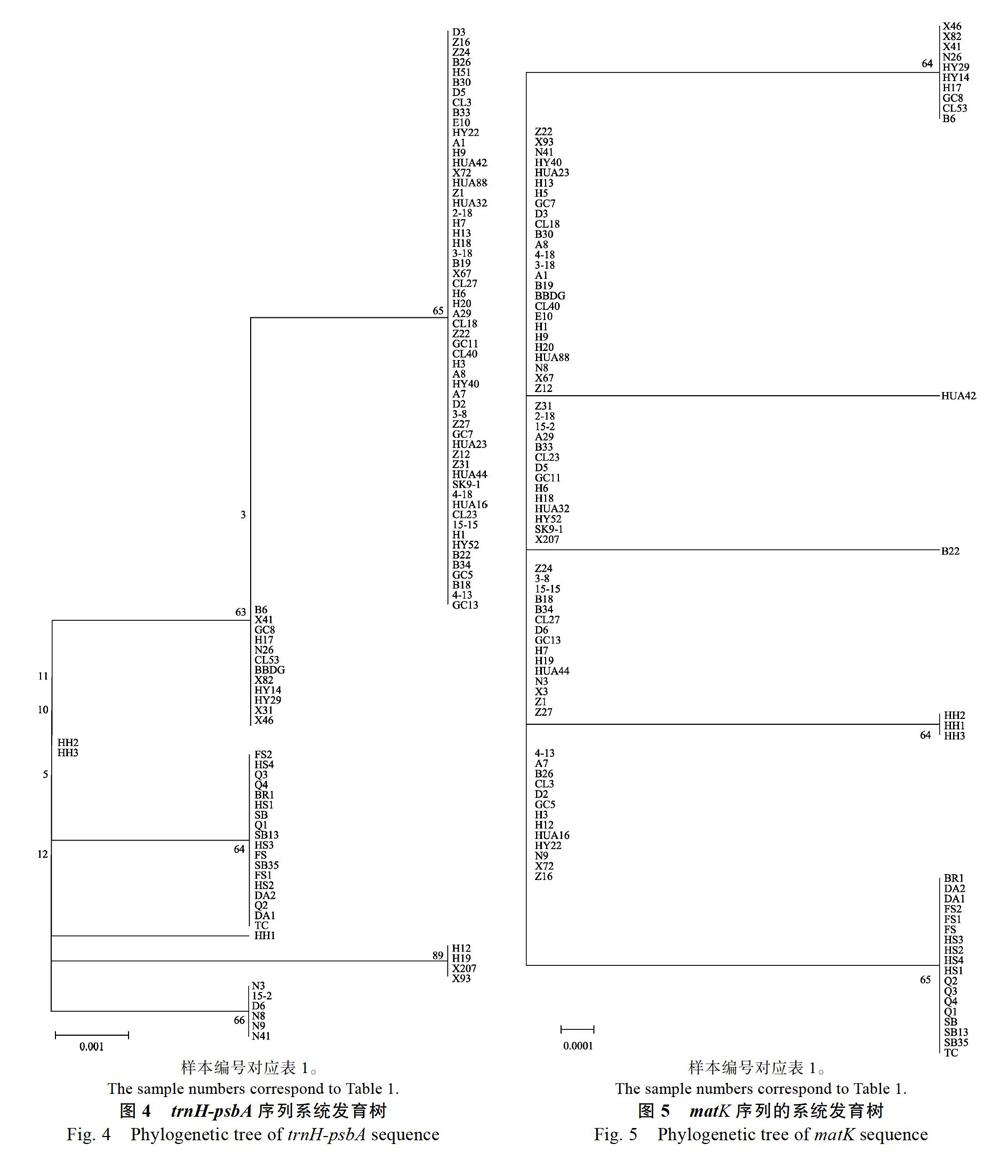
摘 要:為有效鉴别出不同种油茶种苗,收集101份不同种油茶种苗作为试材,其中18份越南油茶、79份普通油茶、1份博白大果油茶、3份红花油茶,利用叶绿体基因组trnH-psbA和matK序列进行扩增并测序分析,随后对序列进行拼接及特征分析,并计算样本种间及种内遗传距离,构建系统发育树。结果表明:101份供试材料的trnH-psbA序列全长381 bp,有10个变异位点,可通过变异位点鉴别出越南油茶、红花油茶及部分普通油茶,系统发育树将越南油茶聚为一支,自展支持率为64%;matK序列全长797 bp,有5个变异位点,可通过变异位点鉴别出越南油茶、红花油茶及部分普通油茶,系统发育树将红花油茶聚为一支,越南油茶聚为一支,自展支持率分别为65%和64%。因此,trnH-psbA序列可对越南油茶进行有效鉴别,而matK序列可对越南油茶和红花油茶进行有效鉴别。该研究结果对避免油茶种苗混杂、规范海南油茶种苗市场有一定的指导意义。
关键词:trnH-psbA序列;matK序列;油茶;DNA条形码
中图分类号:S794.4 文献标识码:A
DNA Barcoding Identification of Different Species in Camellia Based on trnH-psbA and matK Sequences
DAI Jiani1, YU Jing1*, QI Huasha1, ZHENG Wei1, WANG Jian1, WU Yougen1, LAI Hanggui2, HU Xinwen2
1. Institute of Horticulture, Hainan University, Haikou, Hainan 570228, China; 2. College of Tropical Crops, Hainan University, Hai-kou, Hainan 570228, China
Abstract: In order to effectively identify the species of Camellia seedlings, we collected 101 samples of Camellia seedlings as the test materials, including 18 C. vietnamensis, 79 C. oleifera, 1 C. gigantocarpa, and 3 C. chekiangoleosa. In order to identify all the samples effectively, the trnH-psbA and matK sequences of the chloroplast genome were used for amplification and sequencing analysis, followed by splicing and characterization of the sequences. Subsequently, the sequences were spliced and analyzed, and the genetic distances between the samples were calculated, and the phylogenetic tree was constructed. The results showed that the trnH-psbA sequence of the 101 test materials was 381 bp in length and had 10 mutation sites, which could be used to identify C. vietnamensis, C. chekiangoleosa and parts of C. oleifera. Phylogenetic trees gathered C. vietnamensis as a branch with a self-developed support rate of 64%. The matK sequence showed 797 bp in length and had 5 mutation sites. C. vietnamensis, C.chekiangoleosa and parts of C. oleifera could be identified by the mutation sites. The phylogenetic tree showed that all C. chekiangoleosa species were clustered into one branch with a self-developed support rate of 65%, and all C. vietnamensis species were clustered into one branch with a self-developed support rate of 64%. Therefore, the trnH-psbA sequence could be used to identify C. vietnamensis effectively, and the matK sequence could be used to identify C. vietnamensis and C. chekiangoleosa effectively. The results have certain practical significance for avoiding the hybridization of Camellia seedlings as well as regulating the Hainan Camellia seedling market.
Keywords: trnH-psbA sequence; matK sequence; Camellia; DNA barcode
DOI: 10.3969/j.issn.1000-2561.2021.03.001
油茶是山茶科(Theaceae)山茶属(Camellia)中种子油脂含量较高且具有一定经济价值的植物总称,所属物种约有50个,多为常绿小乔木[1]。油茶籽油中不饱和脂肪酸的含量高于90%,此外,还富含植物甾醇、维生素E、多酚、角鲨烯和类胡萝卜素等多种功能性成分,在预防和治疗心脑血管疾病、抗菌消炎、抗老化等方面,均可发挥一定的作用[2]。油茶在中国已有约2000年的栽培历史,是我国四大木本油料作物之一,具有重要的经济、社会和生态价值[3],其在长江流域和亚热带的高山及丘陵地带多有种植[4],分布于湖南、江西、福建等18个省市[5]。……
登录APP查看全文
