临床药师干预抗菌药物应用管理对新生儿血源性感染影响的Meta分析
2021-07-01 07:26:56陈彩霞谭淑文邓敏
中国医学创新
2021年13期
陈彩霞 谭淑文 邓敏


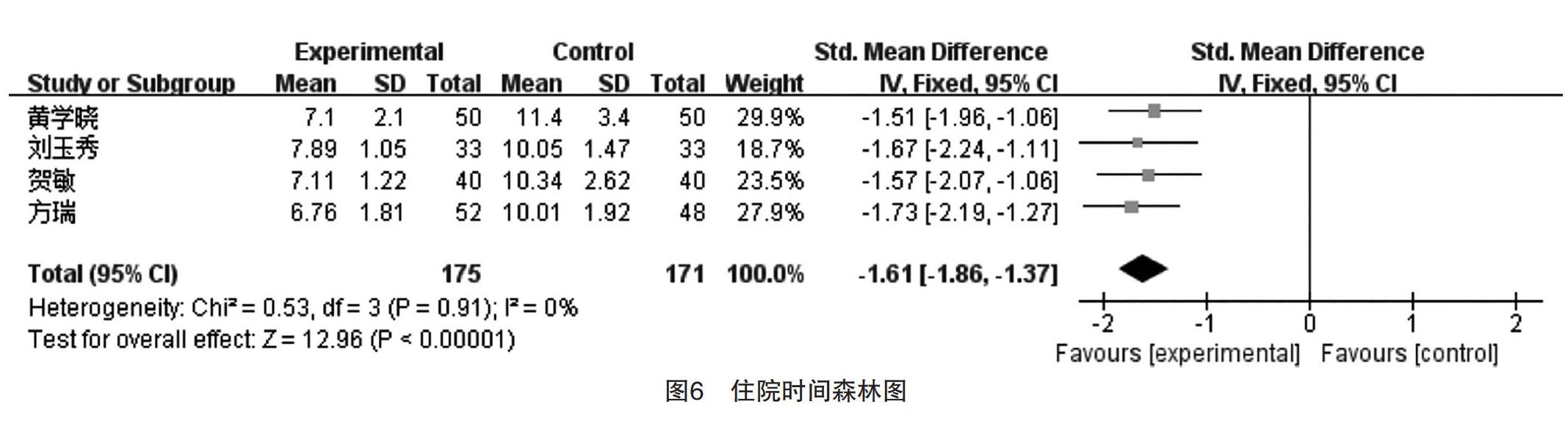
【摘要】 目的:探究臨床药师干预的抗菌药物应用管理对新生儿血源性感染的影响及其Meta分析。方法:计算机检索中国知识资源总库(CNKI)、维普中文科技期刊全文数据库、万方数据学术论文总库、PubMed、Web of Science、Embase、Elsevier等数据库中临床药师干预抗菌药物应用管理对新生儿血源性感染影响的相关文献。对纳入研究的试验根据Jadad评分量表和Cochrane Handbook 5.1评估文献质量和偏倚风险,采用软件Revman 5.0进行新生儿血源性感染(败血症)的治疗总有效率、体温恢复时间及住院时间数据分析。结果:最终有5篇文献被纳入,均为中文文献。5项研究报告了参与临床药师抗菌药物管理后的治疗总有效率,共1 192例患者。异质性检验表明各研究之间存在异质性(I2=79%,P=0.000 6),因此采用随机效应模型进行分析。Meta分析结果表明经临床药师干预管理对新生儿血源性感染的治疗总有效率无明显影响[OR=0.02,95%CI(-0.03,0.07),P=0.39]。本研究的治疗总有效率比较漏斗图分布不对称,表明有小样本低质量研究或发表偏倚的存在。4项研究报告了参与临床药师抗菌药物管理后的患儿体温恢复时间,共346例患者。异质性检验表明各研究之间存在异质性(I2=85%,P=0.000 2),因此采用随机效应模型进行分析。Meta分析结果表明经临床药师干预管理后新生儿血源性感染的体温恢复时间存在一定的差异[OR=-2.50,95%CI(-3.23,-1.76),P<0.000 01]。4项研究报告了临床药师抗菌药物管理后患儿的住院时间,共346例患者。异质性检验表明各研究之间不存在异质性(I2=0,P=0.91),因此采用固定效应模型进行分析。Meta分析结果表明经临床药师干预抗菌药物管理后能够缩短住院时间[OR=-1.61,95%CI(-1.86,-1.37),P<0.000 01]。结论:临床药师干预抗菌药物的应用管理能够缩短患儿体温恢复时间及住院时间,值得推广应用。
【关键词】 药师干预 抗菌药物应用管理 新生儿 血源性感染 Meta分析
Meta-analysis of Clinical Pharmacist Intervention in Antibacterials Application Management on Blood-borne Infections of Newborns/CHEN Caixia, TAN Shuwen, DENG Min. //Medical Innovation of China, 2021, 18(13): -170
[Abstract] Objective: To explore the impact of clinical pharmacist intervention on the application and management of antibacterial drugs on neonatal blood-borne infections and its Meta-analysis. Method: Literature related to the effect of clinical pharmacist intervention in antimicrobial application management on neonatal blood-borne infection was searched from CNKI, VIP Chinese scientific and technical journal full-text database, Wanfang data academic papers database, PubMed, Web of Science, Embase, Elsevier and other databases. The trials included in the study were evaluated for literature quality and risk of bias according to the Jadad score scale and the Cochrane Handbook 5.1. The software Revman 5.0 was used to analyze, the effective rate of treatment, the time of body temperature recovery and the length of hospitalization of neonatal blood-borne infection (sepsis). Result: In the end, 5 literatures were included, all of which were in Chinese. 5 studies reported the total effective rate of 1 192 patients who participated in the administration of antimicrobial agents by clinical pharmacists. Heterogeneity tests showed heterogeneity between studies (I2=79%, P=0.000 6), so a random-effects model was used for the analysis. Meta-analysis results showed that clinical pharmacist intervention management had no significant effect on the total effective rate of neonatal blood-borne infections [OR=0.02, 95%CI (-0.03, 0.07), P=0.39]. The total effective rate of this study was asymmetrical compared with the distribution of funnel plots, indicating the existence of small samples of low-quality studies or publication bias. 4 studies reported the recovery time of body temperature in children who participated in clinical pharmacist antimicrobial administration, including 346 patients. Heterogeneity test showed that there was heterogeneity among the studies (I2=85%, P=0.000 2), so random effects model was used for analysis. The results of Meta-analysis showed that there were certain differences in the recovery time of body temperature of neonates with blood-borne infection after clinical pharmacist intervention [OR=-2.50, 95%CI(-3.23, -1.76), P<0.000 01]. 4 studies reported the length of hospital stay of 346 children treated with antimicrobial agents by clinical pharmacists. Heterogeneity tests showed that there was no heterogeneity between studies (I2=0, P=0.91), so a fixed-effect model was used for analysis. Meta-analysis results showed that intervention by clinical pharmacists in antimicrobial management could shorten the length of hospital stay [OR=-1.61, 95%CI(-1.86, -1.37), P<0.000 01]. Conclusion: Clinical pharmacist intervention in the application and management of antimicrobial agents can shorten the recovery time of body temperature and hospitalization time of children, which is worthy of promotion and application.
[Key words] Pharmacist intervention Antimicrobial application management Newborn Blood-borne infection Meta-analysis
First-authors address: Maoming Hospital of Traditional Chinese Medicine, Maoming 525000, China
doi:10.3969/j.issn.1674-4985.2021.13.040
新生儿血源性感染中最常发生的感染是新生儿败血症,新生儿败血症是新生儿死亡的主要原因之一[1]。……
登录APP查看全文
猜你喜欢
家庭医学(下半月)(2019年9期)2019-10-12 08:04:06
家庭医学(下半月)(2019年8期)2019-09-25 09:02:00
妈妈宝宝(2017年3期)2017-02-21 01:22:12
现代商贸工业(2016年25期)2016-12-26 14:56:36
中外医学研究(2016年26期)2016-11-30 02:38:27
云南中医中药杂志(2016年9期)2016-11-29 08:02:14
风湿病与关节炎(2016年10期)2016-11-23 07:06:16
中国中药杂志(2016年20期)2016-11-19 13:25:02
中国现代医生(2016年23期)2016-11-15 03:22:39
罕少疾病杂志(2016年4期)2016-03-11 16:34:39