介入疗法应用神经内科脑血管病的临床探究
2021-08-09 01:47:35吴洪伦
中华养生保健
2021年2期
关键词:临床疗效
吴洪伦
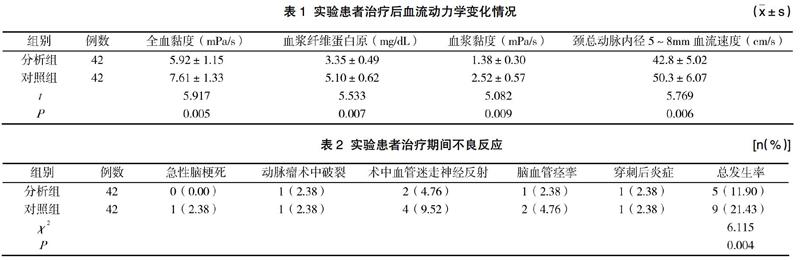
摘 要:目的 研究在治疗脑血管疾病时采用介入疗法的临床疗效。方法 筛选2018年4月~2020年4月期间我院神经内科收治的符合实验要求的脑血管病患者84例,按照电脑数字随机法分为分析组(n=42)和对照组(n=42),分析组患者采用介入疗法治疗,对照组患者采用常规药物治疗,对比两种治疗方式临床效果。结果 分析组患者治疗后血流动力学变化各项指标显著优于对照组,两组数据对比有统计学意义(P<0.01);分析组患者不良反应总发生率低于对照组,两组数据对比有统计学意义(P<0.01)。结论 在治疗脑血管病时采用介入疗法治疗效果更为确切,能有效提高患者的血流动力学水平,改善患者脑血管病临床症状,术后不良反应较小。
关键词:介入疗法;神经内科;脑血管病;临床疗效
中图分类号:R743 文献标识码:A 文章编号:1009-8011(2021)-2-0003-03
Abstract: Objective To study the clinical effect of interventional therapy in the treatment of cerebrovascular diseases. Methods From April 2018 to April 2020,84 patients with cerebrovascular disease who met the experimental requirements were selected from the neurology department of our hospital. According to the computer digital random method, they were divided into the analysis group (n=42) and the control group(n=42). The patients in the analysis group were treated with interventional therapy, while the patients in the control group were treated with conventional drugs,and the clinical effects of the two treatment methods were compared. Results After treatment, the indexes of hemodynamics in the analysis group was significantly better than those in the control group(P<0.01); The total incidence of adverse reactions in the analysis group was obviously lower than those in the control group. There was statistical significance between the two groups(P<0.01). Conclusion Interventional therapy is more effective in the treatment of cerebrovascular disease, which can effectively improve the level of hemodynamics, improve the clinical symptoms of patients with cerebrovascular disease, and have less adverse reactions.
Keywords: Interventional therapy;Internal Medicine-Neurology;Cerebral vascular disease;Clinical efficacy
腦血管疾病是神经内科的常见疾病,主要指一些脑部血管的各种疾病,主要包括脑血栓、脑动脉粥样硬化、动脉狭窄、闭塞脑动脉瘤等疾病,这些疾病共同点是均能引起患者脑组织缺血或出血,一旦发病致残率、致死率非常高[1]。临床常用治疗方式为药物治疗和手术治疗两种,两种治疗方式各有优势,药物治疗方式较为安全,但是临床效果较慢,并不能彻底改善患者的脑血管病症,手术治疗患者的临床效果更为确切,能明显缓解患者的临床症状[2]。所以本文筛选2018年4月~2020年4月期间我院神经内科收治的符合实验要求的脑血管病患者84例,对介入疗法应用神经内科脑血管病的临床效果进行探究。
1 资料与方法
1.1 一般资料
筛选2018年4月~2020年4月期间嘉祥县人民医院神经内科收治的符合实验要求的脑血管病患者84例,按照电脑数字随机法分为分析组(n=42)和对照组(n=42),分析组患者中男性26例,女性16例;年龄分布37~65岁,平均年龄(52.5±2.8)年;病程分布2~9年,平均病程(4.6±1.5)年;其中动脉狭窄11例、脑动脉瘤12例、脑血栓13例、脑梗死6例。……
登录APP查看全文
猜你喜欢
今日健康(2016年12期)2016-11-17 12:55:34
今日健康(2016年12期)2016-11-17 11:53:45
今日健康(2016年12期)2016-11-17 11:36:14
中国实用医药(2016年24期)2016-10-17 05:48:31
中国实用医药(2016年24期)2016-10-17 05:36:56
中国实用医药(2016年24期)2016-10-17 05:23:44
中国实用医药(2016年24期)2016-10-17 05:00:41
中国实用医药(2016年24期)2016-10-17 04:59:50
中国实用医药(2016年24期)2016-10-17 04:47:30
中国实用医药(2016年24期)2016-10-17 04:29:05