
HPLC法测定猪源纤维蛋白粘合剂中的枸橼酸离子含量
2021-09-22 08:22:57蒋玉辉梁蔚阳
中国医药科学
2021年23期
关键词:纤维蛋白原
蒋玉辉 梁蔚阳
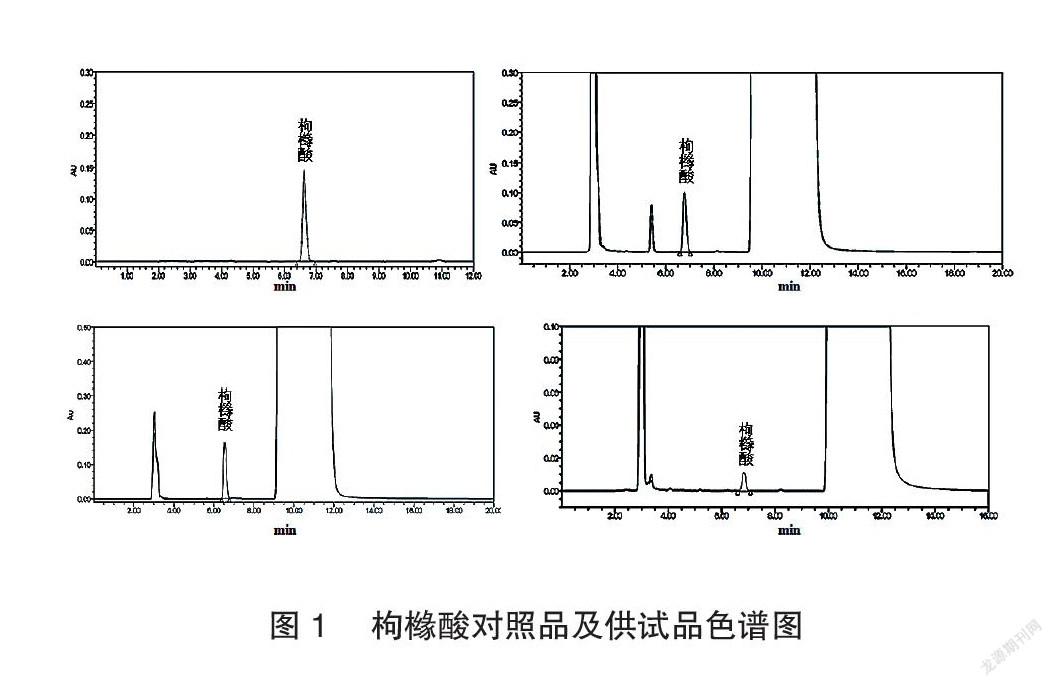
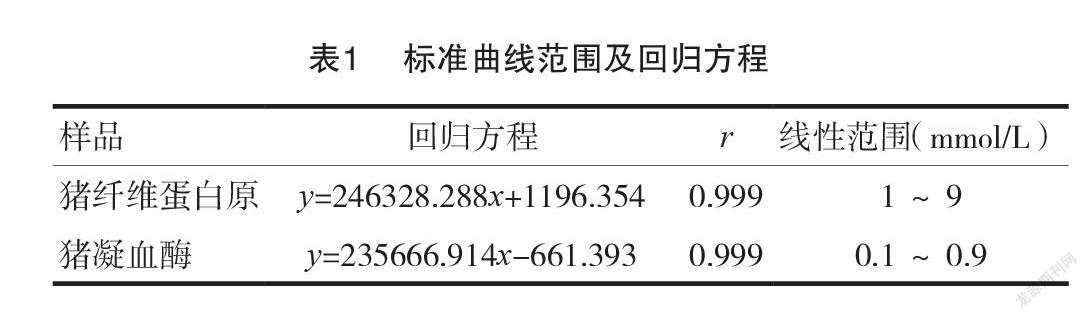

[摘要]目的建立猪源纤维蛋白粘合剂中纤维蛋白原和凝血酶两种成分的枸橼酸离子含量测定的方法。方法采用高效液相色谱法,分析色谱柱为 Welch Ultimate AQ-C18(4.6 mm×250 mm,5μm),流动相为18 mmol/L 的磷酸二氢钠-0.1%异丙醇溶液(磷酸调节 pH 值至2.0),流速1 ml/min,柱温40℃,检测波长210 nm。采用标准曲线法进行分析。结果在该色谱条件下测得纤维蛋白原和凝血酶两种成分中枸橼酸离子的浓度线性范围分别为1~9 mmol/L( r=0.999)、0.1~0.9 mmol/L( r=0.999)。加样回收率分别为99.55%~102.63%( n=18)、99.69%~101.61%(RSD=0.60%, n=12)。结论该方法操作简单,准确性高,专属性强,精密度、重复性、稳定性好,可用于测定猪源纤维蛋白粘合剂中的枸橼酸离子含量。
[关键词]猪源纤维蛋白粘合剂;纤维蛋白原;凝血酶;枸橼酸离子;高效液相色谱法
[中图分类号] R28 [文献标识码] A [文章编号]2095-0616(2021)23-0078-04
Determination of citrate ion in porcine fibrin adhesive by HPLC
JIANG Yuhui LIANG Weiyang
Guangdong Institute for Drug Control, Key Laboratory of Blood Products Quality Control of National Medical Products Administration, Guangdong, Guangzhou 510663, China
[Abstract] Objective To establish a method for determination of citrate ion content of fibrinogen and thrombin in porcine fibrin adhesive. Methods HPLC was used, the analytical column was Welch Ultimate AQ-C18(4.6 mm×250 mm, 5μm), the mobile phase was 18 mmol/L sodium dihydrogen phosphate -0.1% isopropanol solution (the pH value was adjusted to 2.0 by phosphoric acid), the flow rate was 1 ml/min, the column temperature was 40℃ , and the detection wavelength was 210 nm. The standard curve method was used for analyses. Results Under this chromatographic condition, the linear range of citrate concentration in fibrinogen and thrombin was 1-9 mmol/L (r=0.999) and 0.1-0.9 mmol/L (r=0.999), respectively. The sample recovery rate was 99.55%-102.63%(n=18) and 99.69%-101.61%(RSD=0.60%, n=12). Conclusion The method is simple, accurate, specific, precise, reproducible and stable, and can be used for the determination of citrate ion in porcine fibrin adhesive.
[Key words] Porcine fibrin adhesive; Fibrinogen; Thrombin; Citrate ion; High performance liquid chromatography
豬源纤维蛋白粘合剂是从健康猪血浆中分别分离、提纯猪纤维蛋白原和猪凝血酶,并经病毒去除和灭活处理、冻干制成。本品由猪纤维蛋白原及其稀释剂、猪凝血酶及其稀释剂4种成分组成,使用时将纤维蛋白原和凝血酶分别用稀释剂复溶后,同时喷于出血创面,发挥止血作用[1-2]。
猪源纤维蛋白粘合剂中含有的枸橼酸离子为枸橼酸钠,在猪血采集和生产工艺中引入,因其具有局部抗凝的作用[3-4],会影响该药的止血功效,因此在该药品的质量标准中要控制其含量。枸橼酸离子的含量测定,国内外文献报道的方法有紫外-可见分光光度法[5-6]、酸碱滴定法[7]、离子色谱法[8-9]、全自动酶法[10]、高效液相色谱法[11-14]和离子交换-中和滴定法[15]等。……
登录APP查看全文
猜你喜欢
医学信息(2017年3期)2017-02-22 17:18:00
中国实用医药(2016年29期)2016-12-26 10:13:10
中国实用医药(2016年23期)2016-12-26 08:20:40
中外医学研究(2016年28期)2016-11-28 11:35:43
中国现代医生(2016年25期)2016-11-19 10:55:14
中国实用医药(2016年19期)2016-08-05 21:35:49
中国实用医药(2016年11期)2016-05-04 13:57:32
中国实用医药(2016年12期)2016-05-04 12:06:07
中国实用医药(2016年6期)2016-03-17 10:48:50
中国实用医药(2016年5期)2016-02-20 04:06:54
