经皮穴位电刺激辅助麻醉对老年腰椎手术术后应激反应及谵妄的影响
2022-07-13 21:34:29徐贤亮黄仙保余奕军汪文琴夏萍萍
中国医学创新
2022年16期
关键词:应激反应
徐贤亮 黄仙保 余奕军 汪文琴 夏萍萍
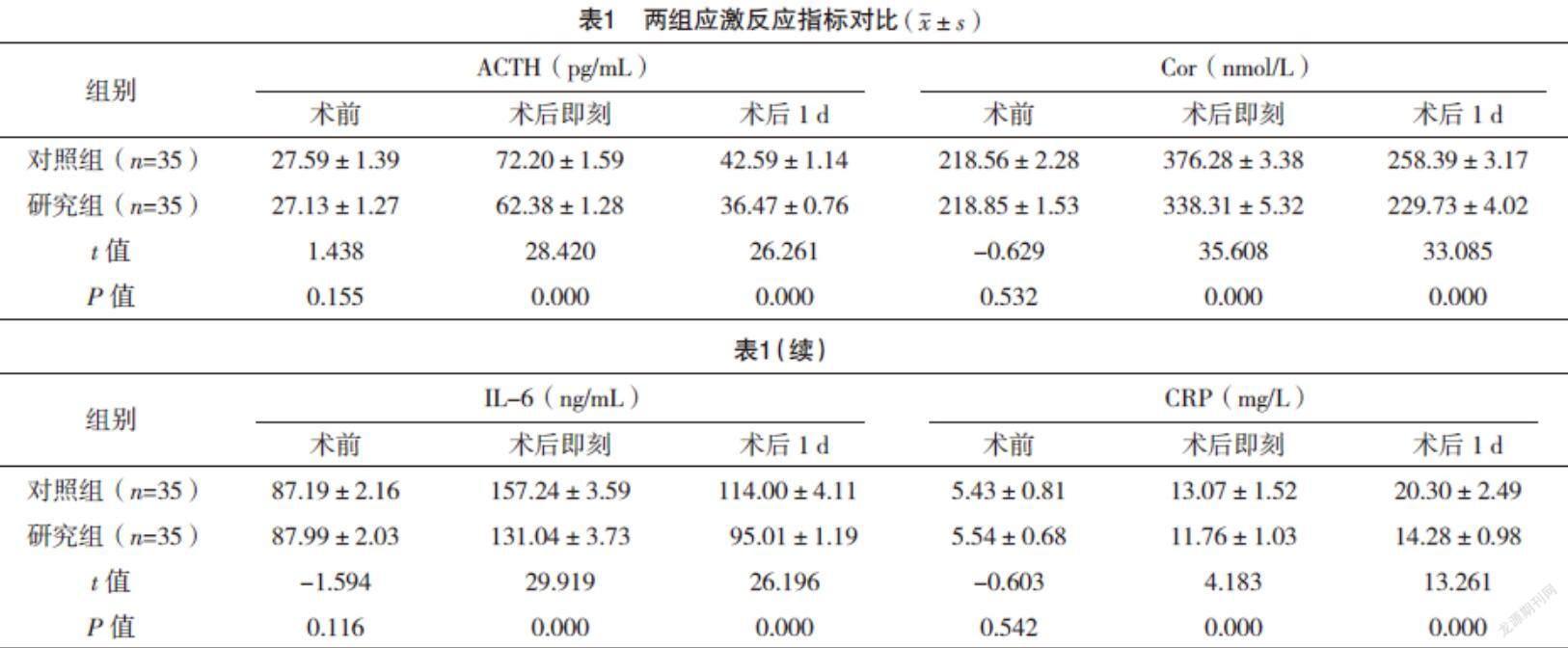
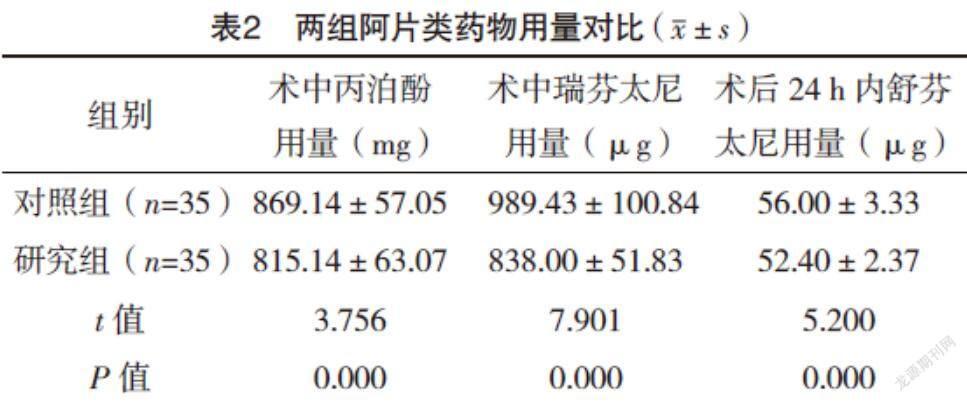

【摘要】 目的:探討经皮穴位电刺激应用于老年腰椎手术麻醉中对术后应激反应及谵妄的影响。方法:选取江西中医药大学附属医院2020年9月-2021年9月收治的70例老年腰椎单节段椎体手术患者作为研究对象,按照随机数字表法将其分为对照组(35例)和研究组(35例),对照组采用常规全身麻醉,研究组采用经皮穴位电刺激辅助麻醉联合全身麻醉。比较两组应激指标、阿片类药物用量、术后疼痛以及术后谵妄发生率。结果:术前,两组促肾上腺皮质激素(ACTH)、皮质醇(Cor)、白细胞介素-6(IL-6)及C反应蛋白(CRP)四项应激指标水平比较,差异均无统计学意义(P>0.05);术后即刻以及术后1 d,与对照组比较,研究组ACTH、Cor、IL-6以及CRP水平均更低(P<0.05)。与对照组比较,研究组术中丙泊酚用量、术中瑞芬太尼用量、术后24 h内舒芬太尼用量均更少(P<0.05)。术后2、4及12 h,与对照组比较,研究组疼痛评分均更低(P<0.05)。研究组术后3 d内谵妄发生率为2.86%,明显低于对照组的20.00%(P<0.05)。结论:老年腰椎手术麻醉时给予经皮穴位电刺激可减轻应激反应,减少麻醉药物用量,缓解疼痛,降低谵妄发生率,可优先选择。
【关键词】 老年腰椎手术 经皮穴位电刺激 应激反应 谵妄
Effects of Percutaneous Acupoint Electrical Stimulation Assisted Anesthesia on Stress Response and Delirium after Lumbar Surgery in the Elderly/XU Xianliang, HUANG Xianbao, YU Yijun, WANG Wenqin, XIA Pingping. //Medical Innovation of China, 2022, 19(16): 0-057
[Abstract] Objective: To investigate the effect of percutaneous acupoint electrical stimulation on postoperative stress response and delirium after lumbar surgery in the elderly. Method: A total of 70 elderly patients undergoing single-segment lumbar vertebral surgery from September 2020 to September 2021 in the Affiliated Hospital of Jiangxi University of Traditional Chinese Medicine were selected as the research objects, they were divided into the control group (35 cases) and the study group (35 cases) according to the random number table method. The control group was given conventional general anesthesia, and the study group was given percutaneous electrical acupoint stimulation combined with general anesthesia. The stress indicators, opioid dosage, postoperative pain and the incidence of postoperative delirium were compared between the two groups. Result: Before operation, there were no significant differences in the levels of four stress indicators of adrenocorticotropic hormone (ACTH), cortisol (Cor), interleukin-6 (IL-6) and C reactive protein (CRP) between the two groups (P>0.05), immediately after operation and 1 day after the operation, compared with the control group, the levels of ACTH, Cor, IL-6 and CRP in the study group were lower (P<0.05). Compared with the control group, the dosage of intraoperative Propofol, intraoperative Remifentanil and Sufentanil within 24 h after operation in the study group were less (P<0.05). At 2, 4 and 12 h after operation, the pain scores of the study group were lower than those of the control group (P<0.05). The incidence of delirium in 3 d after operation in the study group was 2.86%, which was significantly lower than 20.00% in the control group (P<0.05). Conclusion: Percutaneous electrical acupoint stimulation during anesthesia for lumbar spine surgery in the elderly can reduce the stress response, reduce the amount of anesthetic drugs, relieve pain and reduce the incidence of delirium. It is a priority.
[Key words] Lumbar surgery in the elderly Percutaneous acupoint electrical stimulation Stress response Delirium
First-author’s address: Affiliated Hospital of Jiangxi University of Traditional Chinese Medicine, Nanchang 330006, China
doi:10.3969/j.issn.1674-4985.2022.16.012
我国人口呈明显老龄化趋势,老年人患病率及住院率不断上升,全身麻醉外科手术患者也不断增加。老年人群各项机体功能以及耐受力下降,手术操作、疼痛刺激以及麻醉药物等多种原因均可能引起强烈的应激反应,特别是腰椎手术往往手术创伤大,应激反应明显,术后疼痛及全身炎症反应更为剧烈,术后谵妄发生率也相对较高[1-2]。……
登录APP查看全文
猜你喜欢
现代仪器与医疗(2016年6期)2017-01-12 18:24:21
中国医学创新(2016年30期)2016-11-28 00:59:21
中国现代医生(2016年23期)2016-11-15 03:39:34
中国实用医药(2016年16期)2016-07-26 23:07:28
中国实用医药(2016年15期)2016-05-24 09:59:42
中国实用医药(2016年15期)2016-05-24 04:23:35
中国实用医药(2016年10期)2016-05-04 12:21:19
中国实用医药(2016年8期)2016-03-30 22:29:41
中国实用医药(2016年4期)2016-02-23 11:36:02
中国实用医药(2016年3期)2016-01-05 11:16:50