基于Conv-Attention-MLP的新能源汽车电池异常检测方法
2024-05-21 10:40:28陈旭东何宏周焱平
科技资讯
2024年4期
关键词:深度学习
陈旭东 何宏 周焱平
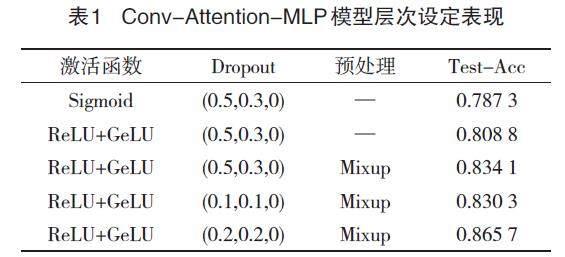
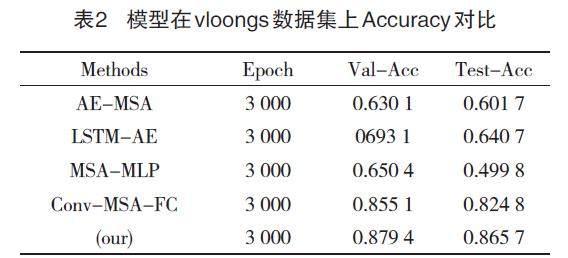
摘 要: 针对于新能源汽车电池异常信号的检测,传统异常检测方法对多个维度电池数据检测精度低、泛化性差等问题,本文提出一种融合了卷积(Conv)、自注意力机制(Attention)和多层感知器(MLP)的Conv-Attention-MLP深度神经网络方法,该方法首先对多个维度的时序数据使用特征卷积进行降维,再利用多头自注意力机制(MultiHead-Self-Attention, MSA)对数据的时间不同步以及数据逻辑之间的重建模,最后经过多层感知机(MLP)的连续线性映射与非线性运算,产生复杂的分段映射,以达到更好的拟合效果。实现了对多个维度电池数据的有效检测,提高了模型对于多样化数据的准确性和稳健性。实驗结果表明,相比于传统异常检测方法,在vloongs数据集上Conv-Attention-MLP模型表现效果更加优越,展现出更高精度和更强的鲁棒性。
关键词:深度学习 异常检测 自注意力机制 模型融合
中图分类号:U472;TP274
The Anomaly Detection Method for New Energy Vehicle Batteries Based on Conv-Attention-MLP
CHEN Xudong HE Hong* ZHOU Yanping
College of Computer and Communication, Hunan Institute of Engineering, Xiangtan, Hunan Province, 411104 China
Abstract: For the detection of abnormal signals in new energy vehicle batteries, traditional anomaly detection methods have issues such as low detection accuracy and poor generalization in multi-dimensional battery data. This paper proposes a Conv-Attention-MLP deep neural network method which integrates convolution (Conv), the self-attention mechanism (Attention) and the multi-layer perceptron (MLP). The method first uses feature convolution to reduce the dimensionality of multi-dimensional time-series data, then uses the multihead self-attention (MSA) mechanism to recmodel the asynchrony of data time and the interrelationships among data logic, and finally uses the continuous linear mapping and non-linear operation of the multi-layer perceptron (MLP) to generate complex piecewise mapping, so as to achieve better fitting results, which realizes the effective detection of multiple-dimensional battery data, and enhances the model's accuracy and robustness for diverse data. Experimental results demonstrate that compared to traditional anomaly detection methods, the the Conv-Attention-MLP model has better performance on the vloongs dataset, showcasing higher precision and stronger robustness.
Key Words: Deep learning; Anomaly detection; Self-attention mechanism; Model merging
锂电池因高能量密度、轻便、低自放电率广用于汽车,但特殊情况下可能发生热失控,危及驾驶人员。目前,新能源汽车电池异常检测算法主要分为两类。无监督学习算法如聚类算法可处理多维特征[1],但缺乏实时监测能力。神经网络算法如LSTM在处理时序性数据方面表现优异[2],但存在梯度消失和梯度爆炸问题。结合两者的新算法,如VAE-LSTM-DTW[3],能有效判断异常,但仍缺乏实时性和边缘部署的效率。
近年来计算机视觉方面的不断发展,对图像处理主要采用卷积神经网络,卷积层使得模型拥有强大的建模能力。Transformer[4]是一种革命性的深度学习模型,其中的自注意力机制(Self-Attention)使得模型能够在处理序列对不同位置的信息进行加权。……
登录APP查看全文
猜你喜欢
中国教育技术装备(2016年19期)2016-12-27 19:23:52
中国远程教育(2016年11期)2016-12-27 18:07:31
现代商贸工业(2016年25期)2016-12-26 09:58:02
江苏教育·中学教学版(2016年11期)2016-12-21 11:45:08
江苏教育·中学教学版(2016年11期)2016-12-21 11:36:29
现代情报(2016年10期)2016-12-15 11:50:53
考试周刊(2016年94期)2016-12-12 12:15:04
新教育时代·教师版(2016年23期)2016-12-06 06:02:38
法制与社会(2016年32期)2016-12-01 15:25:53
软件导刊(2016年9期)2016-11-07 22:20:49