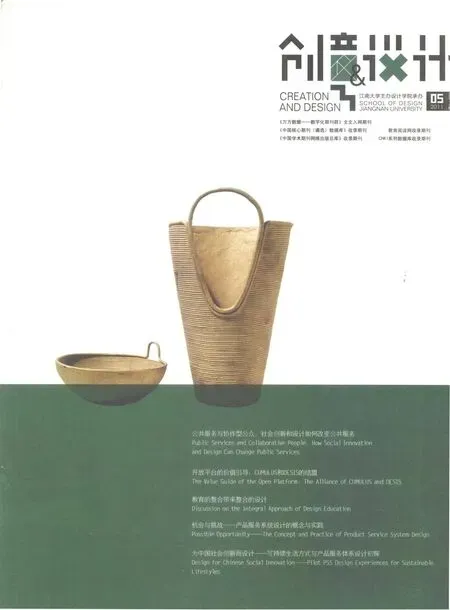
The Cultural Territories of Italian Design
2011-06-08 09:48:10VincenzoCristalloLoredanaDiLucchioLorenzoImbesiTransbyZhengHui
创意与设计
2011年5期
Vincenzo Cristallo, Loredana Di Lucchio, Lorenzo Imbesi Trans. by Zheng Hui
Vincenzo Cristallo(罗马萨皮恩扎数据部研究员,教授,博士)
Vincenzo Cristallo(Researcher Professor, Design Ph.D. - Section Design, DATA Department, Sapienza Università di Roma –vincenzo.cristallo@uniroma1.it)
Loredana Di Lucchio(罗马萨皮恩扎数据部研究员,教授,博士)
Loredana Di Lucchio(Researcher Professor,Design Ph.D. - Section Design, DATA Department,Sapienza Università di Roma -loredana.dilucchio@uniroma1.it)
Lorenzo Imbesi(加拿大卡尔顿大学工业设计学院 副教授,博士)
Lorenzo Imbesi(Associate Professor,DottArch, PhD - SID | School of Industrial Design,Carleton University, Ottawa,Canada - lorenzo_imbesi@carleton.ca)
Introduction
The subject of “experiences” emerges with greater clarity in a possible story about the relationship between the territorial background and the Italian Design.
Experience in doing: where the Italian entrepreneurial capacity was born and which today is being transformed into the inevitable confrontation/ opening to the global system not only regarding production, but especially regarding consumerism that is now determined and administered by information technologies.
Experience in living: where objects, habits,contexts are elements correlated to one same scenario that in Italy presents itself in a different way every time, a multiple yet comprising one same character, the value of lived experience.
Experience in thinking: those who have allowed Italian design to imagine new territories:this time not geographical but social ones that,through the visions of Radical Design, have led to today’s experiences linked to new technologies on one side and to new forms of production and consumerism on the other – where the concept of cultural community supersedes that of proximal community.
These three kind of experiences are linked with three issues, which informed the evolution of Italian Design: the economic and productive issue,the cultural and behavioural issue, the critical and ethical issue.

Fig.1 UMBRELLA STAND Umbrella Stand Made of Polish Brushed Brass Design: Scott Fellows & Craig Bassam Production:Bassamfellows
Morphogenetic Territories
In the 1960s and 1970s, during the crisis of the Fordist production model and what some deemed to be an irreversible decline of large industrial firms and hierarchical function structures, groups of small but extremely vibrant compagnie were discovered in certain Italian regions: employment remained steady, there was frequent innovation and exports were increasing. The situation became the focus of a national and international debate. It was soon revealed that the locations of these companies were not dictated by chance, as they had roots in territorial systems with singular social characteristics.
This led to the “small is beautiful” phenomenon,which borrowed its name from an important book by the economist Ernst Friedrich Schumacher(1973) which criticized Western economies and favoured the adoption of more human-oriented,decentralized and appropriate technologies.

Fig.2 UMBRELLA STAND Umbrella Stand Made of Polish Brushed Brass Design: Scott Fellows & Craig Bassam Production:Bassamfellows

Fig.3 UMBRELLA STAND Umbrella Stand Made of Polish Brushed Brass Design: Scott Fellows & Craig Bassam Production:Bassamfellows

Fig.4 FLORA Wall Copper Sheet Decoration Design: Tord Boontje Production: Artecnica

Fig.5 FLORA Wall Copper Sheet Decoration Design: Tord Boontje Production: Artecnica
This quintessentially Italian phenomenon showed that the advantages of large-scale production could also be obtained by a network of small companies that were located near to each other. Each of the firms would specialize in a particular phase of the production process or the production of a particular component.Some of them would have direct contact with the end market. Most importantly, the economic relationships were made more efficient by the ties based on personal acquaintanceships, shared values and a sense of belonging.
In 1989, Giacomo Becattini drew on the work of the English economist Alfred
Marshall (1870) and gave a clear, decisive name to this phenomenon: industrial districts.Becattini adapted the Marshallian concepts to the Italian context, describing a district as a local community in which small companies operate.
This milieu constitutes a social, cultural and institutional territory. In a complex evolution process, since that time the Italian production system – both in economic theories and elsewhere– has become intricately bound to the concept of“territory”, with social and cultural outlooks being replaced with economic views of production processes. In physical terms, a territory is a portion of land within boundaries (Devoto-Oli Italian dictionary, 2006), but when it comes to districts a territory is a means of communication,and a vehicle and focus of work, production,interaction and co-operation (Dematteis, 1985).
The importance of the territory as a place for communication thus became a cornerstone of the origin and originality of Italian production:communication, work, interaction and cooperation are the very elements that help to assert what has been known since that time as the so-called Made in Italy model. However, the elements mentioned are not normal economic characteristics. The elements in question are the various social relationships that individuals and the group as a whole have in a specific time and place: they are James Coleman’s “social capital”,based on “authority”, “trust” and “regulatory”relationships. In this fertile breeding ground,the unique Italian bond between design and production emerged and developed around the same forms of relationships, especially in terms of trust. Consequently, design in Italy is not just one of the activities in Porter’s value chain, whose importance and need for good management became apparent in the 1980s and 1990s.Around the same time, the discipline of design management established itself, with authors taking the typical Italian relationship between design and production as a model. However, these authors do not seem to have grasped the importance of territory as a social capital system in which design plays a key role. What results would have been achieved by the exquisite theoretical capabilities– based on morphological and semantic aspects– of the great masters of Italian design such as Castiglioni, Sottsass, Ponti and Magistretti, if they had not been complemented by the technical know-how and tacit knowledge of companies and their social contexts, and businesses that concentrated more on culture than on economic guidelines? A huge impact on this relationshipbased business model hinging on the territory was inevitable over the last twenty years, which have seen the completion of the globalization process which was already being discussed in economic circles in the 1960s in its positive sense as a phenomenon of progressive growth in international interaction.
Leaving aside economic and sociological definitions, globalization has been a multifaceted phenomenon which is based more on the evolution of relationship systems than on simple exchanges of goods. It has taken place thanks to real-time progress in information and communication technology and the shift of values from tangible goods (a production-based economy) to intangible goods (a knowledgebased economy). Rather than making things more uniform, this process has led to a bigger gulf in the nature and speed of development. It has driven a slow process of deconstruction of existing contexts and redefinition around a map based on opportunities rather than proximity.
Against the backdrop of this profound alteration of proximal relationships at the start of the 21st century, the territory has taken on a new value for Italian production, and therefore for Italian design. There has been a shift from the features of Becattini’s districts – as complete,morphostatic systems – to open, morphogenetic systems like moving districts in which the levels of interaction are different: a) There is a level linked to the origins, in which the territory gives rise to the creation of companies and provides the know-how on which the businesses are built;b) There is a level linked to development, in which the territory is the place where companies find the resources to conduct their business and increase their profits; c) There is a level linked to the network, in which the territory no longer has physical points of reference but interacts in a virtual manner, using unions and partnerships as ways to “extend” the territory. A new geography has thus been drawn up. Instead of weakening the established cultural interaction,the processes taking place revitalize it and lead to transformation of a symbolic nature (of the image and conception of territories) and effective changes (to action, organizational set-ups,innovative strategies and cooperation). In this new geographical layout, Italian design can no longer be portrayed using the specialist production models of the districts (such as chairs in Udine,furniture in Brianza, eyewear in Belluno, shoes in Ancona and textiles in Biella) which are linked exclusively to the first level of the origins. The new territories of Italian design are – and must be – based around development and networks,with values, know-how and talent driving them.The proximity (employing the model of virtual communities) is now cognitive rather than physical.
This means that there are now aesthetic territories, material territories, technical territories, experiential territories, social territories and “other” territories.
Repositories of Knowledge
The constant references to the unique, broad range of contents of the Italian design system have deep roots. These roots lie beneath a large plant with many branches, leavesand fruits. In addition to the fruits (products), its presence can be felt in tacit knowledge, relationships and experiences.
Other metaphors to express the idea might be that Italian design is a tale with a number of storylines, a map covered in numerous routes,and a language with various dialects. Any abuse of courteous allegory for a gilded scenario outlining the singular characteristics of Italy and its cultural heritage can be justified and excused, as it is an unparalleled repository in which regional and local products and services are always seen in a positive light. The introduction of the term“repository” is essential, as it underlines the fact that the presence of assets in certain parts of Italy is a result of its heritage and a combination of environmental, human and cultural factors that have influenced its life and development throughout all of its small and large happenings. It is a “unique setting” whose originality lies in both the qualities of its raw materials and in the output from the production chains. It is possible to examine the value of resources using a definition based on the product-context-identity sequence.
In Italy, as in the rest of the Mediterranean area, this relationship is behind the generative input of a material culture with large quantities of values and symbols. Links such as these reveal that what we sometimes generically consider to be parts of the territorial heritage are actually assets whose complexity means that there is a clear distinction between the place of origin and the main identifying properties. Economic studies into local production see the territory as a large company and recognize economic models within it – frequently of an “informal”nature – that revolve around production based on the combination between typical resources and high quality know-how. This is the only explanation for the high design input that can be found amongst our parishes and parochialisms, in products ranging from Jew’s harps and Brunello di Montalcino wine to the Gondolas of Venice.
They are iconic products that represent their local areas. We have included them with scientific speculation under the umbrella of “Italian design”and as part of the national language, but they are actually full of dialectal nuances.
The concept of a “repository” is used to embody a local resource in a limited area.Therefore, a typical Italian “territorial repository”is an established system made up of numerous correlated, interacting factors: human resources,production resources, historical and cultural differences, and environmental and monumental physical elements that create a multi-faceted identity. This inclusive definition of “repositories”goes beyond all specific descriptions and largely brings into play self-referencing properties. In terms of production, they give goods the role of a territorial medium. In Italy, as well as being possible, specific definitions of repository are necessary. Leading the way in terms of numbers and diversity is the cultural model, which arises from a complex blend of scientific, historical and artistic traditions that have taken shape and been conveyed at different times. This mixture is extremely variable when it comes to geography,time and space, and in each area it refers to the presence of tangible and intangible cultural assets that encapsulate the human presence over the course of history. If the repository is natural, its unique qualities, integrity and diffusion will be based around the environment system. This is the source of its distinctive heritage, which derives from the physical vocations of a territory (such as the sea or the mountains) and stretches further– in its intentions at least – than the traditional labelling by “spots” (exclusive habitats) or “strips”(coastlines or mountain ranges).
The result is a description of an integral system with balance between all of the physical parts and services.

Fig.6 VINE Wall Copper Sheet Decoration Design: Susan Bradley

Fig.7 VINE Wall Copper Sheet Decoration Design: Susan Bradley

Fig.8 APPUNTI DI VIAGGIO Coffee Table Made of Copper Sheet Design: Lorenzo Damiani

Fig.9 APPUNTI DI VIAGGIO Coffee Table Made of Copper Sheet Design: Lorenzo Damiani

Fig.10 NEONATURAL Wall Copper Sheet Decoration Design: Riccardo Giovanetti Production: Fielitz

Fig.11 NEONATURAL Wall Copper Sheet Decoration Design: Riccardo Giovanetti Production: Fielitz

Fig.12 NEONATURAL Wall Copper Sheet Decoration Design: Riccardo Giovanetti Production: Fielitz

Fig.13 NEONATURAL Wall Copper Sheet Decoration Design: Riccardo Giovanetti Production: Fielitz

Fig.14 JAIL Vases for Plants With Copper Structure And Natural Earthenware Case Design:Eli Gutierrez Production: Guerra
It is much quicker to define a gastronomic repository. The debate about this matter is a very topical one in Italy. Due consideration has led to gastronomic repositories being seen as a unique way of summing up the relationship between products and settings, so they are portrayed as representatives of an area’s identity and used to defend it. Old workshops, mills, wineries and stores should be seen as an “operative” museum of tangible culture. The human input in terms of creativity and knowledge is handed down from one generation to the next and these venues have every right to be placed alongside popular destinations, art museums, churches and monuments on the tourist routes for “foodtrotters” and “gastronauts” (Paolini, 2000).
They are also “metaphorical places” that are home to original working traditions which are impossible to replace with alternative technical approaches and are worthy of protection and assistance, in a process similar to that of the restoration of a monument, a film or a painting.Preservation of them and the resulting production of goods and services boosts the defence and conservation of the territory. However, especially with the new forms of cultural tourism, this is reliant on the development of a network for all of the local players who contribute to the rediscovery and conservation of repositories. It is necessary to convince people that the local knowledge is a key,emblematic quality of production areas. Nobody should be surprised to hear that cheese, deli meats, pasta, confectionery, wines and liqueurs deserve to be part of the national heritage, on an equal standing in some ways with the more cultured area of works of art. Repositories thus give substance to the identity of a territory.
The identity of a setting – and also of a product, given the renewed outlooks on the heritage of tradition and knowledge – embodies the entire range of factors and values resulting from the course of events and from interweaving,overlapping historical and cultural experiences.This incomparable heritage is reproduced in images and symbols, physical and monumental elements, and goods that have had an impact on the life, development and relationships of the Italian people and the nation of Italy.
Critical Territories
Looking beyond industry and mass production, critical experimentation deserves recognition for the role it plays as an important sphere of Italian design output. It has found social aspects to be a particularly fertile area of research.Every design project has a social impact and all of the results become part of the daily interaction between people, often changing the form and quality of their relationships. Acknowledgement of this fact leads to an approach which places the immediate functionality of form in the background and focuses more on subtle stimulation of the thoughts of onlookers.
Design thus becomes a tool for political reflection – or even protest and activism – that challenges the public and its expectations. It goes as far as questioning the role of the designer and the act of creation itself within society. Design thus becomes a group activity, or a fleeting occasion to be distributed socially and shared horizontally, outside the official realm of the design star system.
Public space is often at the centre of attention and the workplace of designers.
In the years of the avant-garde experimentation of Radical Design, the Urboeffimeri by the ufo group appeared alongside the landscape schemes by Gianni Pettena and Riccardo Dalisi’s workshops with the urban proletariat. More recently, similar sensitivity has been seen in the space exploration by Stalker,Cliostraat’s urban crossovers and Esterni’s collective experiments.
Public space in this sense not only means the physical area at the heart of the design work– which is often urban/metropolitan – but also the location of social interaction/relationships between men and women.
The aim of the designer is not just to build solid objects, but to rework social structures through performative events akin to situations which can be organized spontaneously and take place briefly, but shake up established meanings and functions. This underlines the situationist outlook of Italian design, which plays with the Debordian society of the spectacle and consumption of culture through popular reappropriation. With good understanding of the value of communicative language and organizational skills of an equally high level, the technique of estrangement is used in design to construct ludic situations and create an artistic environment that embraces the entire social dimension. Emerging from all of this are direct action, provocative behaviour, ironic nonsense,political protest, hybrid crossovers, displacement and disorientation.
The projects reflect social emergencies, tell creative stories and play with chance happenings,often revealing the process behind their existence,which is never linear and involves continual cross-references and quotations. The catalogue that emerges is in contrast with all classical takes on the scale of the situation: they are not just physical objects, nor indeed are they pieces of built architecture or urban structures.The collapse of the scales between design,architecture, landscapes, products and graphics gives renewed complexity to design and makes users into members of the community. Instead of being consumers, they become part of a broader interactive environmental scenario.
The relationship with new technology is just as critical: instead of using them as high performance tools for innovation and bringing the design process to an end with them, the expressive capacities and creative possibilities that new technologies present are explored.Throughout the history of Italian industry, there has always been an intricate relationship with technology. Rather than portraying an invention as a value in itself, its aesthetic and poetic potential is explored, thus revealing its hidden beauty and the combination of form, process and concept. Unlike a hard take on things, which would highlight the cultural differences with the objects to which we have become accustomed, this soft research tends to conceal the technology and hybridize it in everyday items. One of the seminal experiences of this kind was put together by the Interaction Design Institute in Ivrea. Instead of presenting a new model of computer or mobile phone, special wallpaper, smart typewriters and strange vintage fiat 500s went on display, with special interactive intelligence concealed in each item. Artistic adaptations of technology produce cognitive goods that go beyond strictly technical and functional needs to create genuine interactive poetry and electronic narration which involves users on an emotional and a social level.
Technology goes from offering hope for the future and life improvement to becoming a source of obsession and fear. The expedient of narrative becomes a tool of research and experimentation that focuses on the new roles, contexts and approaches to design with regard to the social,cultural and ethical impact of emerging and existing technology, and explores its possibilities in life and everyday surroundings. When looking into the biotechnologies that are about to emerge from scientific laboratories, Elio Caccavale constructs things such as social fiction scenarios.“Macro” elements associated with politics, the economy and society come to the fore alongside the “micro” aspects of daily life, interpersonal relationships and the smallest behavioural characteristics. The resulting picture is not just of our dreams and the things that we want, but also of the most unpleasant and unexpected consequences, whose depiction can serve as a warning. Once again, outside industry no one can take the final outcome for granted.

Fig.15 JAIL Vases for Plants With Copper Structure And Natural Earthenware Case Design:Eli Gutierrez Production: Guerra

Fig.16 JAIL Vases for Plants With Copper Structure And Natural Earthenware Case Design:Eli Gutierrez Production: Guerra

Fig.17 JAIL Vases for Plants With Copper Structure And Natural Earthenware Case Design:Eli Gutierrez Production: Guerra

Fig.18 LATVA Brass Clothes Stand Design: Mikko Laakkonen Production: Covo
(1)L. Di Lucchio is the author of paragraph 1, V.Cristallo is the author of paragraph 2, L. Imbesi is the author of paragraph 3
Bibliography
[1]P. Antonelli (2008). Design and Elastic Mind.USA: The Museum of Modern Art, New York.
[2]AA.VV. (2007). The New Italian Design. Il paesaggio mobile del nuovo design italiano.IT: Ed. Grafiche Milani, Milano.
[3]G. Becattini, (1989), Riflessioni sul distretto industriale marshalliano come concetto socio-economico, in Stato e mercato(vol. 25), IT: Il Mulino, Bologna.
[4]F. Benhamou ( 2001), L’economia della cultura, IT: Il Mulino, Bologna a)Branzi (2006), Modernità debole e diffusa.Il mondo del progetto all'inizio del XXI secolo. IT: Skira, Milano.
[5]G. Dematteis (1985), Le metafore della tera.La geografia umana tra mito e scienza, IT:Feltrinelli, Milano .
[6]L. Di Lucchio (2005), Il design delle strategie.Un modello interpretativo della relazione tra designe impresa, IT: Edizione Gangemi, Roma.
[7]R. Fagnoni, P. Gambaro, C. Vannicola, (2004),Medesign, forme del Mediterraneo,IT:Alinea editrice, Firenze.
[8]R. Grassi, M. Meneguzzo (2002), La valorizzazione del patrimonio culturale per lo sviluppo locale, in Primo rapporto annuale di Federculture, IT: Touring Editore, Milano[9]L. Imbesi (2009), InterAction by Design.DIID vol. 39, IT: RDesignPress, Roma.
[10]D. Paolini ( 2000), I luoghi del Gusto. Cibo e territorio come risorsa di marketing, IT:Bakdini&Castoldi, Milano.
[11]G. Pettena, (2004). Radical design. Ricerca e progetto dagli anni '60 a oggi. IT:Maschietto Editore, Firenze.
[12]P. Nuraghi, S. Stringa (2008), Cultura e territorio. Beni e attività culturali.Valorizzazione e indotto in prospettiva europea, IT: Franco Angeli, Milano.
[13]R. Sennet (2008), The craftsman, USA: Yale University Press, New Haven .
[14]E. F. Schumacher (1973), Small Is Beautiful:Economics As If People Mattered, UK: Blond &Briggs, London.
译文:
一、简介
地域背景和意大利设计之间的关系随着“经验”的增加而越发清晰。
行为的经验:意大利企业家能力诞生的地方,今天转化为不可避免的挑战,并向全球体系开放。这不仅和生产相关,还与由信息技术决定和管理的消费主义有关。
生活的经验:物品,习惯,环境都是和同一个情境相关联的元素。在意大利,这种情境每次表现的方式都不相同。虽然多样,但是都包含生活经验的价值这一个共同的元素。
思考的经验:有些人已经允许意大利设计重新划分领域,但这次不再是以地域的标准划分,而是从社会的角度划分。借着“激进设计”(Radical design)的观点,一方面把现在的经验和新兴的科学技术联系在一起,另一方面把它与生产的新形式联系在一起。文化社区的观念已经取代了邻近社区的观念。
这三种经验与显示意大利设计演变的三个问题相关联,即经济与生产的问题,文化和行为的问题,批判和伦理的问题。
二、形态领域
上世纪六七十年代,福特生产模型和一些被认为必然走下坡路的大型工业企业遭遇危机,在意大利某些区域出现了一批规模小但充满活力的公司。这些公司雇佣稳定,创新不断,出口增加。这样的情况引发了全国甚至全球的范围内的讨论。不久,人们发现这批公司的地理位置的设定绝非偶然,因为它们都扎根于有着不同寻常社会特征的地域体系。……
登录APP查看全文
猜你喜欢
小学科学(学生版)(2020年10期)2020-10-28 07:52:12
现代装饰(2020年7期)2020-07-27 01:27:42
流行色(2020年1期)2020-04-28 11:16:38
中国化肥信息(2020年7期)2020-03-19 01:54:02
艺术启蒙(2018年7期)2018-08-23 09:14:18
中国军转民(2017年6期)2018-01-31 02:22:28
海峡姐妹(2017年7期)2017-07-31 19:08:17
Coco薇(2017年5期)2017-06-05 08:53:16
汽车零部件(2014年11期)2014-09-18 11:57:16
机械制造文摘(焊接分册)(2014年5期)2014-03-20 13:57:44