
咪达唑仑在PICU机械通气危重患儿镇静管理中的应用效果评价
2020-07-01 01:50:13陈江龙
中国实用医药
2020年15期
关键词:机械通气
陈江龙
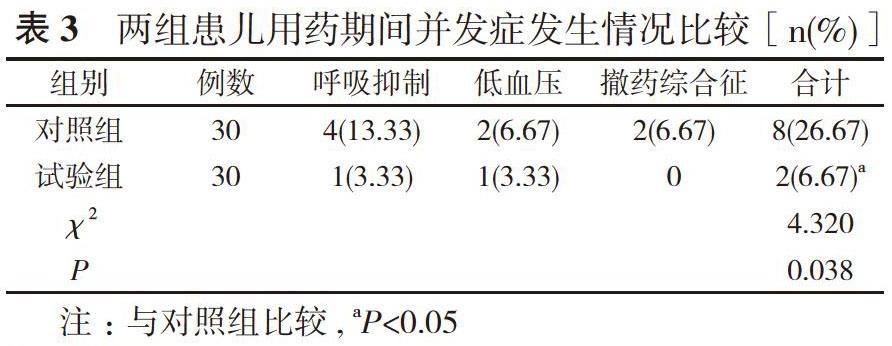


【摘要】 目的 评价咪达唑仑在儿科重症监护病房(PICU)机械通气危重患儿镇静管理中的应用效果。方法 60例需要长时间镇静管理的PICU机械通气危重患儿, 根据入院时间分为对照组和试验组, 各30例。对照组采用地西泮进行镇静管理, 试验组采用咪达唑仑进行镇静管理。对比两组患儿治疗前后呼吸、心率(HR)、血氧饱和度(SpO2)、动脉血氧分压(PaO2)、动脉血二氧化碳分压(PaCO2);机械通气时间、PICU住院时间;用药期间并发症发生情况。结果 治疗后, 试验组患兒呼吸(38.70±4.85)次/min、HR(124.42±10.06)次/min、SpO2(93.46±0.87)%、PaO2(66.42±5.61)mm Hg(1 mm Hg=0.133 kPa)、PaCO2(50.24±4.68)mm Hg均明显优于对照组的(49.06±7.05)次/min、(155.06±12.26)次/min、(91.08±0.90)%、(55.75±5.48)mm Hg、(60.18±4.62)mm Hg, 差异具有统计学意义(P<0.05)。试验组患儿机械通气时间(119.36±13.54)h及PICU住院时间(171.58±30.72)h均明显短于对照组的(132.83±21.03)、(198.39±35.44)h, 差异具有统计学意义(P<0.05)。试验组患儿并发症发生率6.67%低于对照组的26.67%, 差异具有统计学意义(P<0.05)。结论 对于需要长时间镇静管理的PICU机械通气危重患儿, 咪达唑仑镇静作用显著, 并发症发生率低, 更适合儿科患儿应用。
【关键词】 儿科重症监护病房;机械通气;危重患儿;咪达唑仑;镇静管理
DOI:10.14163/j.cnki.11-5547/r.2020.15.040
Evaluation of the effect of midazolam in sedation management of critically ill children with mechanical ventilation in PICU CHEN Jiang-long. Yunfu Municipal Peoples Hospital, Yunfu 527300, China
【Abstract】 Objective To evaluate the effect of midazolam in sedation management of critically ill children with mechanical ventilation in pediatric intensive care unit (PICU). Methods A total of 60 critically ill children with long-term sedation management of PICU mechanical ventilation were divided into control group and experimental group by admission time, with 30 cases in each group. The control group received diazepam for sedation management, and the experimental group received midazolam for sedation management. The respiration, heart rate (HR), oxygen saturation (SpO2), arterial oxygen partial pressure (PaO2), arterial carbon dioxide partial pressure (PaCO2) before and after treatment, mechanical ventilation time, PICU hospitalization time, and occurrence of complications during medication were compared between the two groups. Results After treatment, the respiration (38.70±4.85) times/min, HR (124.42±10.06) times/min, SpO2 (93.46±0.87)%, PaO2 (66.42±5.61) mm Hg (1 mm Hg=0.133 kPa) and PaCO2 (50.24±4.68)mm Hg of the experimental group were obviously better than those of the control group (49.06±7.05) times/min, (155.06±12.26) times/min, (91.08±0.90)%、(55.75±5.48) mm Hg and (60.18±4.62) mm Hg, and the difference was statistically significant (P<0.05). The mechanical ventilation time (119.36±13.54) h and PICU hospitalization time (171.58±30.72) h of the experimental group were obviously shorter than those of the control group (132.83±21.03) and (198.39±
35.44) h, and the difference was statistically significant (P<0.05). The incidence of complications 6.67% of the experimental group was lower than that of the control group 26.67%, and the difference was statistically significant (P<0.05). Conclusion For critically ill children requiring long-term sedation management of PICU mechanical ventilation, midazolam has a significant sedative effect and a low incidence of complications, which is more suitable for pediatric patients.
【Key words】 Pediatric intensive care unit; Mechanical ventilation; Critically ill children; Midazolam; Sedation management
机械通气危重患儿在儿科重症监护病房(pediatric intensive care unit, PICU)内离开家长的陪护, 独自面对陌生环境, 加之疾病本身或有创侵入性操作的影响, 患儿极易出现恐惧、焦虑等情绪, 严重影响患儿的预后, 因此, 需要通过各种安全有效的操作治疗减轻机械通气危重患儿的应激反应程度, 帮助患儿顺利度过危重应急期[1]。目前, 针对PICU机械通气危重患儿应用镇静药是儿科危重病急救医学所面临的一项新课题, PICU中常用的药物包括:苯二氮类药物安定、咪达唑仑、劳拉西泮等, 其中, 国内外应用较多的是咪达唑仑, 而本地区仍以地西泮为主, 为了评价PICU机械通气危重患儿应用咪达唑仑进行镇静管理的效果, 现分析报告如下。
1 资料与方法
1. 1 一般资料 选取2015年1月~2018年12月本院收治的60例需要长时间镇静管理的PICU机械通气危重患儿, 根据入院时间分为对照组和试验组, 各30例。……
登录APP查看全文
猜你喜欢
心脑血管病防治(2016年5期)2016-12-19 07:31:36
中国实用医药(2016年28期)2016-12-07 22:51:33
中国实用医药(2016年28期)2016-12-07 21:36:59
中国实用医药(2016年27期)2016-11-30 13:54:36
中国实用医药(2016年26期)2016-11-07 12:14:07
中国实用医药(2016年24期)2016-10-17 05:53:10
饮食与健康·下旬刊(2016年7期)2016-05-10 13:07:44
中国实用医药(2016年8期)2016-03-30 22:35:29
