
镜像疗法结合徒手淋巴引流对脑卒中肩手综合征及上肢功能的疗效观察
2021-02-15 14:11:16林梦情俞坤强周敏亚吴李秀
中国现代医生
2021年36期
林梦情 俞坤强 周敏亚 吴李秀
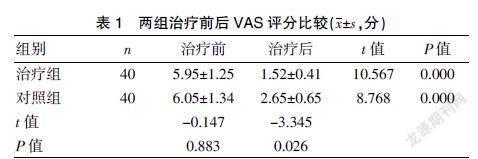
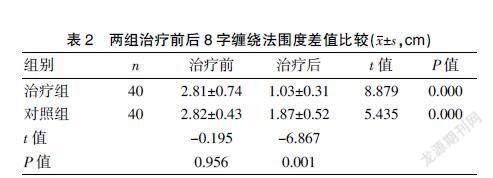
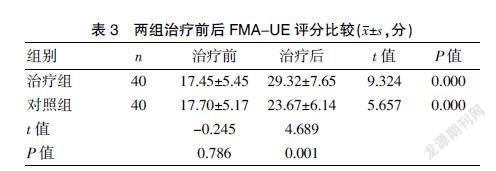
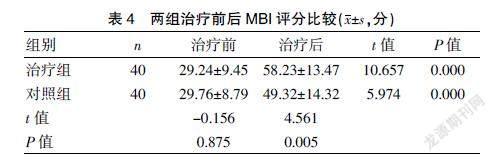
[摘要] 目的 觀察镜像疗法结合徒手淋巴引流对脑卒中肩手综合征Ⅰ期患者的临床疗效。 方法 选取2018年3月至2019年9月收治的80例脑卒中肩手综合征Ⅰ期患者,按随机数字表法分为对照组(n=40)和治疗组(n=40)。对照组给予常规的康复训练,治疗组在对照组基础上给予镜像疗法结合徒手淋巴引流治疗。治疗前和治疗 4周后分别采用视觉模拟评分(VAS)、8字缠绕法围度差值、Fugl-Meyer评定量表上肢部分(FMA-UE)及改良 Barthel指数(MBI)对患者进行康复评定。 结果 治疗4周后,两组VAS评分、8字缠绕法围度差值均低于治疗前,FMA-UE、MBI评分均高于治疗前(P<0.001),治疗组VAS评分、8字缠绕法围度差值均低于对照组,FMA-UE、MBI评分均高于对照组(P<0.05)。 结论 镜像疗法结合徒手淋巴引流可以有效改善脑卒中肩手综合征患者的临床症状,同时改善患者的上肢运功功能及日常生活活动能力。
[关键词] 镜像疗法;徒手淋巴引流;肩手综合征;脑卒中
[中图分类号] R743.3 [文献标识码] B [文章编号] 1673-9701(2021)36-0084-04
Observation on curative effect of mirror therapy combined with unarmed lymphatic drainage on shoulder-hand syndrome and upper limb function after stroke
LIN Mengqing YU Kunqiang ZHOU Minya WU Lixiu
Department of Rehabilitation Medicine, the Second People′s Hospital of Lishui in Zhejiang Rrovince, Lishui 323000, China
[Abstract] Objective To observe the clinical effect of mirror therapy combined with unarmed lymphatic drainage on stroke patients with stage I shoulder-hand syndrome (SHS). Methods From March 2018 to September 2019, 80 stroke patients with stage I SHS were randomly divided into the control group (n=40) and the treatment group (n=40). The control group was given routine rehabilitation training, while the treatment group was given mirror therapy combined with unarmed lymphatic drainage on the basis of the control group. Before treatment and after 4 weeks of treatment, the patients were evaluated by visual analogue scale (VAS), circumference difference of 8-character winding method, Fugl-Meyer assessment-upper extremity (FMA-UE) and modified Barthel index (MBI). Results After 4 weeks of treatment, the scores of VAS, the difference of circumference of 8-character winding method in the two groups were all lower than those before treatment,FMA-UE, MBI scores in the two groups were all higher than those before treatment (P<0.001), VAS and the difference of circumference of 8-character winding method in the treatment group were lower than those in the control group, FMA-UE and MBI scores were higher than those in the control group (P<0.05). Conclusion Mirror therapy combined with unarmed lymphatic drainage can effectively improve the clinical symptoms, and improve upper limb function and activity of daily living of stroke patients with stage I SHS.
[Key words] Mirror therapy; Unarmed lymphatic drainage; Shoulder-hand syndrome; Stroke
肩手综合征(Shoulder-hand syndrome,SHS)在临床上又被称之为反射性交感神经营养不良,其在脑卒中患者中发病率为23%~70%[1]。其临床表现可分为三期,其中Ⅰ期主要表现为上肢肿胀、疼痛及功能障碍。目前在临床上普遍采用药物、理疗及针刺等方法治疗SHS,虽然治疗手段种类繁多,但此类方法的疗效并不确切,缺乏特异性的治疗方法[2-3],因此寻求简便、有效的综合治疗措施,成为当前研究SHS的重要课题。镜像疗法由Ramachandran等[4]在1995年首次提出应用于患肢痛的治疗,目前在脑卒中患者运动功能恢复中运用广泛[5]。……
登录APP查看全文
猜你喜欢
中国实用医药(2016年35期)2017-05-27 17:59:43
右江医学(2016年5期)2017-05-06 15:04:27
今日健康(2016年12期)2016-11-17 13:04:21
中国实用医药(2016年24期)2016-10-17 06:05:29
中国实用医药(2016年24期)2016-10-17 05:56:32
中国实用医药(2016年24期)2016-10-17 05:47:48
中国实用医药(2016年24期)2016-10-17 05:30:14
中国医药科学(2016年5期)2016-10-08 05:05:13
中国民族民间医药·下半月(2016年3期)2016-04-19 12:47:01
养生保健指南(2016年4期)2016-03-22 11:53:54
