醒脑开窍针法联合体外冲击波治疗对脑卒中后肩手综合征的康复效果
2021-04-02 03:38:38曹建平蔡礼松戴方瑜
中国现代医生
2021年5期
曹建平 蔡礼松 戴方瑜
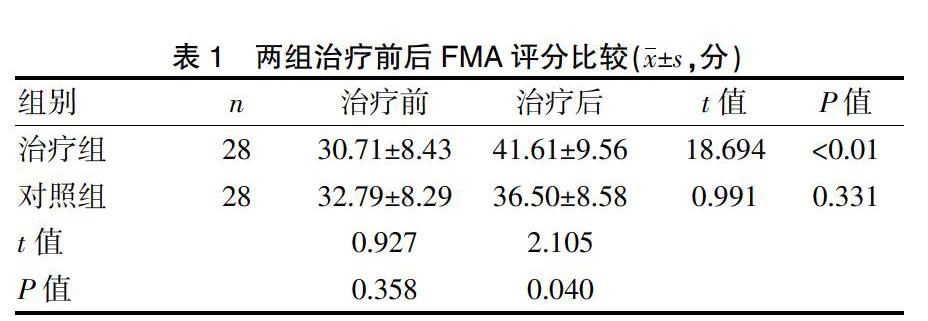
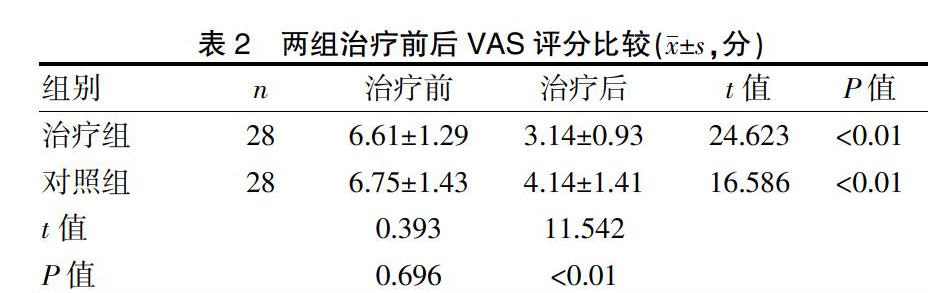
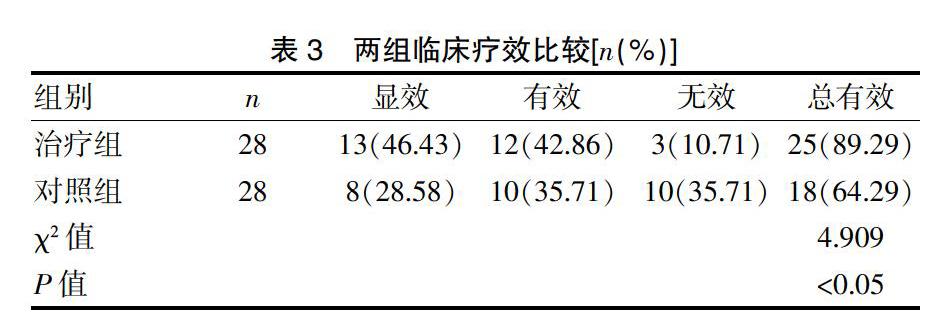
[摘要] 目的 观察醒脑开窍针法联合体外冲击波治疗对脑卒中后肩手综合征的康复效果。 方法 选择2017年7月至2019年6月于浙江省舟山医院康复医学科脑卒中存在肩手综合征功能障碍的56例患者,采用随机对照法以入院先后顺序随机分为对照组和治疗组。每组各28例。在常规药物、康复治疗基础上,对照组给予单纯醒脑开窍针刺法治疗,治疗组给予醒脑开窍针刺法结合体外冲击波治疗。根据上肢Fugl-Meyer运动功能评分法(FMA)、视觉模拟评分法(VAS)、疗效标准等指标评价两组患者临床疗效,观察治疗4周后患者肩手综合征功能障碍的改善情况。结果 治疗后治疗组FMA评分较治疗前明显升高(P<0.05),对照组治疗前后FMA评分比较,差异无统计学意义(P>0.05);治疗前两组患者FMA评分比较,差异无统计学意义(P>0.05),治疗后治疗组FMA评分明显高于对照组,差异有统计学意义(P<0.05)。治疗后两组VAS评分均较治疗前明显降低(P<0.05),治疗组VAS评分显著低于对照组,差异有统计学意义(P<0.05)。治疗组总有效率为89.29%,明显高于对照组的64.29%,差异有统计学意義(P<0.05)。 结论 醒脑开窍针法联合体外冲击波治疗对脑卒中后肩手综合征的临床疗效优于单纯给予醒脑开窍针刺治疗。
[关键词] 醒脑开窍针法;体外冲击波;脑卒中;肩手综合征
[Abstract] Objective To observe the clinical effect of Xingnao Kaiqiao Acupuncture combined with extracorporeal shock wave therapy on shoulder-hand syndrome after stroke. Methods Fifty-six stroke patients with shoulder and hand syndrome dysfunction in department of rehabilitation medicine of Zhoushan Hospital in Zhejiang Province from July 2017 to June 2019 were selected and randomly divided into the control group and the treatment group in the order of admission, with 28 cases in each group. On the basis of conventional medicine and rehabilitation treatment, the control group was given Xingnao Kaiqiao Acupuncture treatment alone, and the treatment group was given Xingnao Kaiqiao Acupuncture treatment combined with extracorporeal shock wave treatment. The clinical efficacy between the two groups was evaluated according to the upper limb motor function Fugl-Meyer (FMA) score, visual comparison score (VAS), efficacy criteria and other indicators. The improvement of patients with shoulder-hand syndrome dysfunction after 4 weeks of treatment was observed. Results The FMA score in the treatment group after treatment was higher that before treatment(P<0.05), and there was no significant difference of the FMA score in the control group before and after treatment(P>0.05). The FMA score in the treatment group was higher than that in the control group, with significant difference(P<0.05). The VAS score between the two groups after treatment was significantly lower than that before treatment(P<0.05), and the VAS in the treatment group was significantly lower than that in the control group, with significant difference(P<0.05). The total effective rate in the treatment group was 89.29%, which was significantly higher than that of(64.29%) in the control group, with significant difference(P<0.05). Conclusion The clinical effect of Xingnao Kaiqiao Acupuncture combined with extracorporeal shock wave therapy on shoulder-hand syndrome after stroke is better than that of Xingnao Kaiqiao Acupuncture.
[Key words] Xingnao Kaiqiao Acupuncture;Extracorporeal shock wave;Stroke;Shoulder-hand syndrome
脑卒中又称中风,是临床最常见的脑血管疾病之一,常伴随一侧或双侧肢体活动障碍、认知障碍、吞咽困难、言语障碍、肩手综合征等多种并发症,该病的致残率、致死率愈发增高,严重危及患者的日常生活功能与身心健康[1-2]。脑卒中后肩手综合征是卒中后最常见并发症之一,亦称反射性交感神经营养不良,一般出现在脑卒中后的1~3个月内。该并发症发生率较高,主要临床表现为患侧肩关节及手腕部疼痛,部分患者出现手腕部水肿,上肢功能活动受限,部分造成肩、手、腕、指的永久性畸形,是影响脑卒中后上肢功能恢复的重要原因,进而严重影响患者日常生活能力[3-4]。目……
登录APP查看全文
猜你喜欢
中国实用医药(2016年35期)2017-05-27 17:59:43
右江医学(2016年5期)2017-05-06 15:04:27
今日健康(2016年12期)2016-11-17 13:04:21
中国实用医药(2016年24期)2016-10-17 06:05:29
中国实用医药(2016年24期)2016-10-17 05:56:32
中国实用医药(2016年24期)2016-10-17 05:47:48
中国实用医药(2016年24期)2016-10-17 05:30:14
中国医药科学(2016年5期)2016-10-08 05:05:13
中国民族民间医药·下半月(2016年3期)2016-04-19 12:47:01
养生保健指南(2016年4期)2016-03-22 11:53:54