广东茶园杂草危害评价与分级方法的建立与探讨
2021-09-03 03:59:40林威鹏张泰劼郑海郜礼阳曾斌李煦红舒灿伟高旭华蔡昆争操君喜
中国茶叶
2021年7期
林威鹏 张泰劼 郑海 郜礼阳 曾斌 李煦红 舒灿伟 高旭华 蔡昆争 操君喜
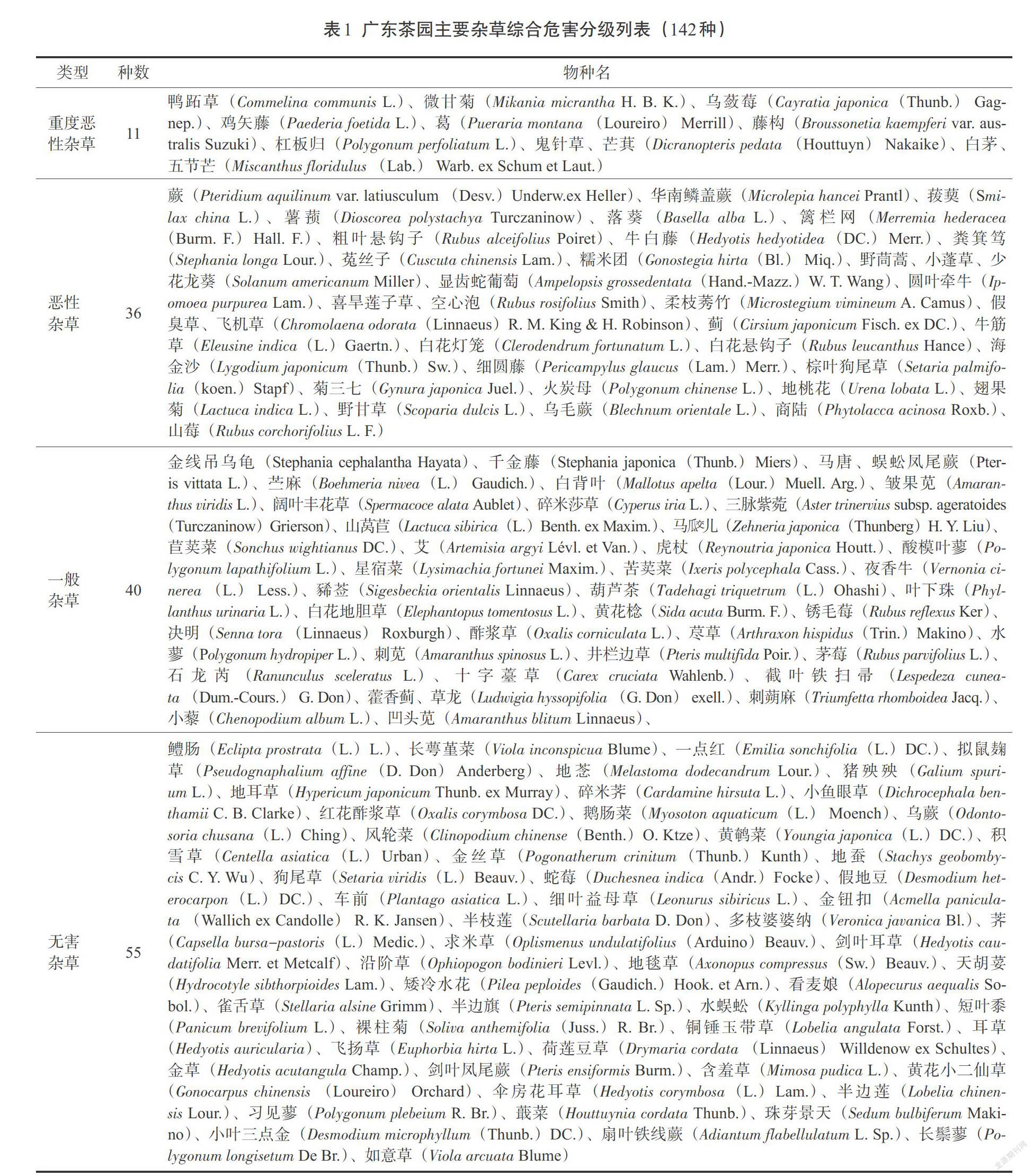
摘要:草類是茶园生态系统的重要组成部分,具有保持水土、改良土壤、栖息天敌等多重功能,对维持茶园生态系统内稳态具有重要意义。然而,目前广东大部分茶企(农)采用了“一刀切”的方式,对草类进行无差别的防控措施,既耗费大量人力、物力、财力,又严重破坏茶园生态系统平衡。因此,建立广东茶园杂草危害评价与分级方法,对指导茶企(农)科学防治杂草具有重要意义。文章从建立茶园杂草危害评价与分级方法的必要性和可行性、国内茶园杂草评价与分级方法的探索和广东茶园杂草危害评价与分级方法的初探等3个方面展开,针对广东茶区产地特点,提出以发生频级、生长优势度、分布系数、防治难度为指标的杂草危害评价和分级方法,以期为茶园杂草的科学防控及茶-草和谐共生系统的构建提供参考建议。
关键词:茶园;草类;危害评估;分级方法;绿色发展
Establishment and Discussion on the
Evaluation and Classification Method of
Weeds in Guangdong Tea Gardens
LIN Weipeng1,2, ZHANG Taijie3, ZHENG Hai4, GAO Liyang1, ZENG Bin1, LI Xuhong1,
SHU Canwei5, GAO Xuhua6, CAI Kunzheng7, CAO Junxi1*
1. Tea Research Institute, Guangdong Academy of Agricultural Sciences/Guangdong Key Laboratory of Tea Plant
Resources Innovation & Utilization, Guangzhou 510640, China; 2. Guangzhou Hoire Intelligent Technology Co., Ltd.,
Guangzhou 510663, China; 3. Plant Protection Research Institute, Guangdong Academy of Agricultural Sciences/
Guangdong Key Laboratory of High Technology for Plant Protection, Guangzhou 510640, China; 4. Guangdong
Food and Drug Vocational College, Guangzhou 510520, China; 5. College of Agriculture, South China Agricultural
University/Guangdong Provincial Key Laboratory of Microbial Signals and Disease Control, Guangzhou 510640, China;
6. Institute of Bioengineering, Guangdong Academy of Sciences, Guangzhou 510316, China; 7. College of Natural
Resources and Environment, South China Agricultural University/Guangdong Provincial Key
Laboratory of Eco-CircularAgriculture, Guangzhou 510640, China
Abstract: As the important components of tea garden ecosystem, grasses have multiple functions including soil and
water conservation, soil improvement and natural enemy habitat. They have great significance in maintaining the
homeostasis of tea garden ecosystem. However, at present, most tea enterprises (farmers) in Guangdong adopt the
"one size fits all" weed control and non-selective weed control method, which wastes a lot of labor and seriously
damages the balance of tea garden ecosystem. Therefore, it is greatly significant to guide tea enterprises (farmers) to
carry out scientific methods for controlling weeds through establishing evaluation and classification method of weeds
in Guangdong tea gardens. In this study, the necessity and feasibility of weed hazard assessment in tea garden, the
assessment and classification methods of domestic weed hazards were discussed. According to the characteristics of
tea producing areas in Guangdong, the indicators of weed hazard assessment and classification methods were proposed,
including occurrence frequency, growth dominance, distribution coefficient and controlling difficulty. This study also
provided advices for scientific weed control in tea gardens and would help to build a harmonious tea grass symbiotic
system.
Keywords: tea garden, weeds, hazard evaluation, grading method, green development
2015年党的十八届五中全会首次提出“创新、协调、绿色、开放、共享”的五大发展理念。在茶产业方面,各省(市、区)主要以“生态茶园建设”为抓手,践行绿色发展理念。目前,已有福建、广东等12个省(市、区)组织制定了地方性或行业性生态茶园建设标准或规范。为推动生态茶园建设,2015—2021年,农业农村部、全国农业技术推广服务中心连续7年分别在福建福安(2015)、山东日照(2016)、湖南安化(2017)、湖北恩施(2018)、安徽六安(2019)、广东英德(2020)、陕西汉中(2021)举办全国茶叶绿色高质高效生产模式及配套技术培训班。……
登录APP查看全文