术后早期被动康复运动对肩袖撕裂患者肩关节镜下手术效果的影响
2021-10-22 05:15:28岳永峰孟羿赵万里
右江医学
2021年9期
岳永峰 孟羿 赵万里


【摘要】 目的 探究術后早期被动康复运动对肩袖撕裂患者肩关节镜下手术效果的影响。
方法 选取2020年1月~8月接受关节镜下手术治疗的肩袖撕裂患者76例,使用随机数表将患者分为观察组和对照组各38例。对照组手术后进行常规康复干预,观察组在对照组的基础上进行早期被动康复运动干预。在干预前(手术结束后)及干预2周、干预6个月后采用美国加州大学肩关节评分系统(UCLA)对患者进行评价,采用视觉模拟评分法(visual analogue scale,VAS)进行疼痛评估,采用关节活动度(range of motion,ROM)量表进行关节活动度评估,采用自制满意度调查量表,通过干预技术、医师态度评分对患者满意度进行评价。使用生活质量综合评定问卷-74评价患者生活质量。
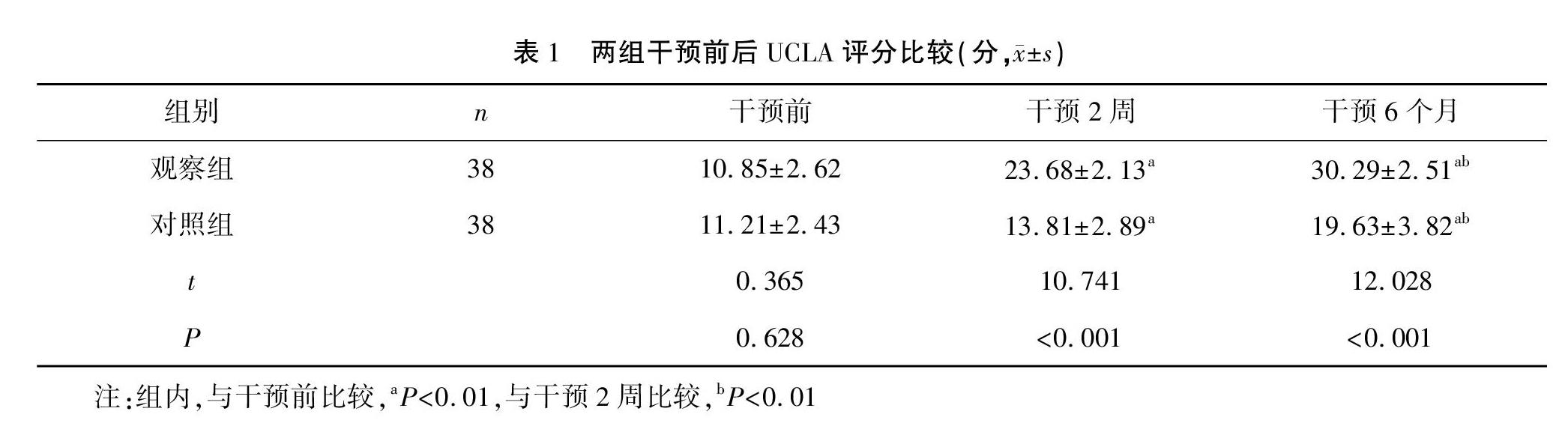
结果 干预2周、干预6个月后,两组UCLA得分均显著升高(P<0.01),并且观察组UCLA得分均高于对照组(P<0.01)。干预2周、干预6个月后,两组VAS得分均显著降低(P<0.01),并且观察组VAS得分均低于对照组(P<0.001)。干预2周、干预6个月后观察组肩关节活动度评分均高于对照组(P<0.01)。干预6个月后观察组满意度评价得分高于对照组(P<0.001)。干预前两组患者生活质量比较差异无统计学意义(P>0.05),干预2周和6个月后,观察组患者在躯体、心理、社会以及物质生活等维度的得分均高于对照组(P<0.01)。
结论 肩袖撕裂患者肩关节镜下术后早期被动康复运动,能够显著改善患者关节活动度,降低患者疼痛水平,增加患者的满意度,提高患者的生活质量和治疗效果,改善预后。
【关键词】 被动康复运动;早期;肩袖撕裂;关节镜手术;关节功能;生活质量
中图分类号:R684 文献标志码:A DOI:10.3969/j.issn.1003-1383.2021.09.004
Effect of early postoperative passive rehabilitation exercise on effect of shoulder arthroscopic surgery in patients with rotator cuff tear
YUE Yongfeng, MENG Yi, ZHAO Wanli
(Department of Orthopedics, The Second Affiliated Hospital of Nanyang Medical College, Nanyang 473500, Henan, China)
【Abstract】 Objective To explore the influence of early postoperative passive rehabilitation exercise on effect of arthroscopic surgery in patients with rotator cuff tear.
Methods 76 patients with rotator cuff tears who received arthroscopic surgery in our hospital from January to August 2020 were selected and randomly divided into observation group and control group, with 38 cases in each group. The control group were given routine rehabilitation intervention after operation, while the observation group were given early passive rehabilitation exercise intervention on the basis of the control group. The patients were evaluated by the university of California at Los Angeles shoulder rating scale (UCLA) before intervention (after operation), 2 weeks and 6 months after intervention, and the pain was evaluated by visual analog scale (VAS). The range of motion (ROM) scale was used to evaluate the range of motion. The self-made satisfaction survey scale was used to evaluate patient's satisfaction through intervention technology and physician attitude score. In addition, the quality of life of patients was evaluated by comprehensive quality of life questionnaire-74.
Results After 2 weeks and 6 months of intervention, the UCLA scores of the two groups increased significantly (P < 0.01), and the UCLA scores of the observation group were higher than those of the control group (P < 0.01). After 2 weeks and 6 months of intervention, the VAS scores of both groups decreased significantly, and the VAS scores in the observation group were lower than those in the control group (P < 0.001). After 2 weeks and 6 months of intervention, the ROM scores of the observation group were higher than those of the control group(P < 0.01). After 6 months of intervention, the satisfaction evaluation score of the observation group was significantly higher than that of the control group (P < 0.001). Before intervention, there was no statistically significant difference in the quality of life comparison between the two groups (P > 0.05), and after 2 weeks and 6 months of the intervention, the observation group had higher scores in physical, psychological, social, and physical life dimensions than the control group (P < 0.01).
Conclusion After arthroscopic surgery for rotator cuff tears, early passive rehabilitation exercise can significantly improve the ranges of motion, reduce pain levels, increase the satisfaction, improve the quality of life and treatment effects of patients, and improve the prognosis.
【Key words】 passive rehabilitation exercise; early; rotator cuff tear; arthroscopic surgery; function of joint; quality of life
肩袖主要是由冈上肌、肩胛下肌、小圆肌及冈下肌的肌腱所组成的复合体[1~2]。肩袖撕裂(rotator cuff tear,RCT) 多由间接暴力引起,临床上主要表现为肩关节疼痛[3~4]。肩周肌群力量减弱、主动活动受限及肌肉萎缩,是成年人群肩关节疼痛和功能障碍的主要引发原因之一。……
登录APP查看全文
猜你喜欢
中国民族民间医药·下半月(2017年1期)2017-03-07 23:19:15
中国医药科学(2016年13期)2017-02-06 17:28:11
中国实用医药(2016年28期)2016-12-07 07:35:05
中外医学研究(2016年28期)2016-11-28 11:46:34
美与时代·美术学刊(2016年9期)2016-11-22 21:21:06
今日健康(2016年12期)2016-11-17 13:43:42
今日健康(2016年12期)2016-11-17 13:31:00
中国现代医生(2016年23期)2016-11-15 03:14:57
出版广角(2016年15期)2016-10-18 00:42:02
饮食与健康·下旬刊(2016年7期)2016-05-10 12:45:11