
腹腔镜直肠癌根治术中保留左结肠动脉的前瞻性随机对照研究
2021-03-22 19:27:16胡军罗俊峰周文斌李包根吕玉良
中国医学创新
2021年30期
关键词:腹腔镜
胡军 罗俊峰 周文斌 李包根 吕玉良
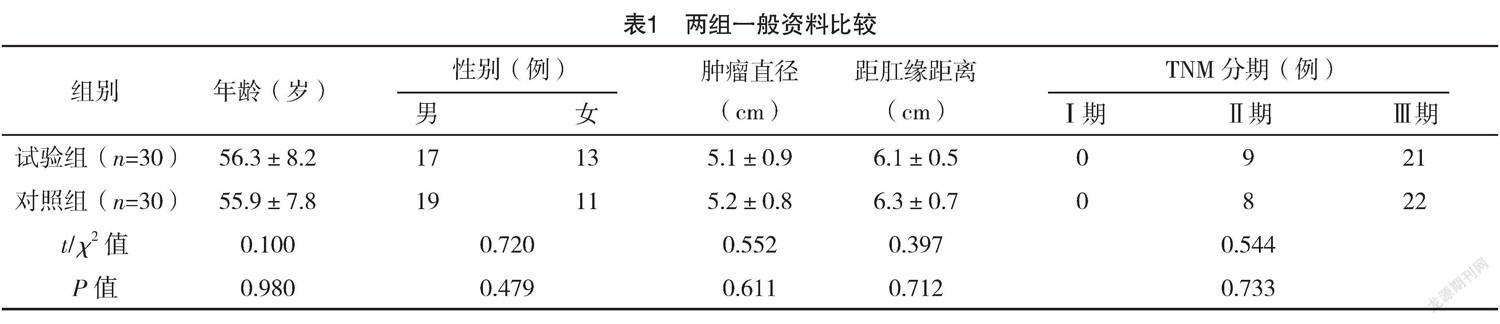
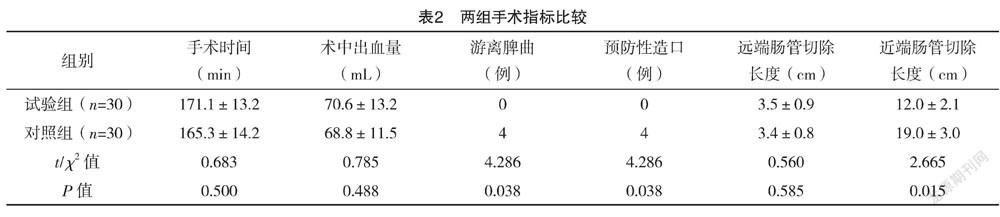
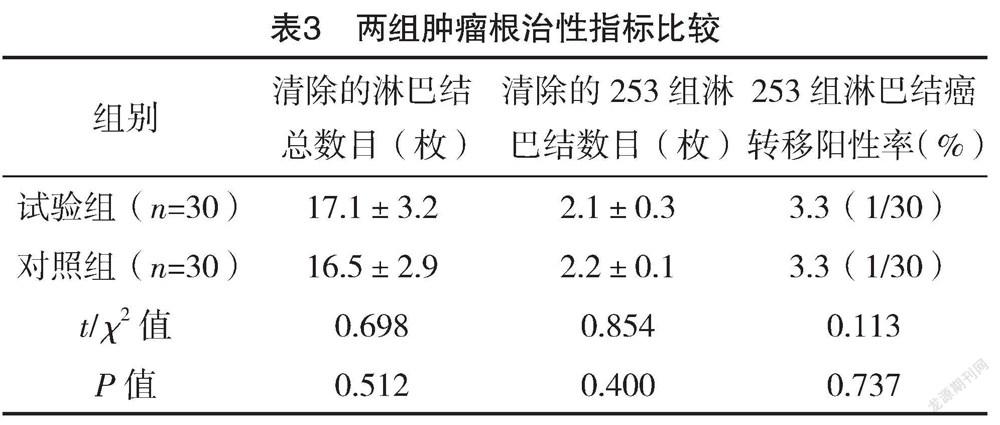
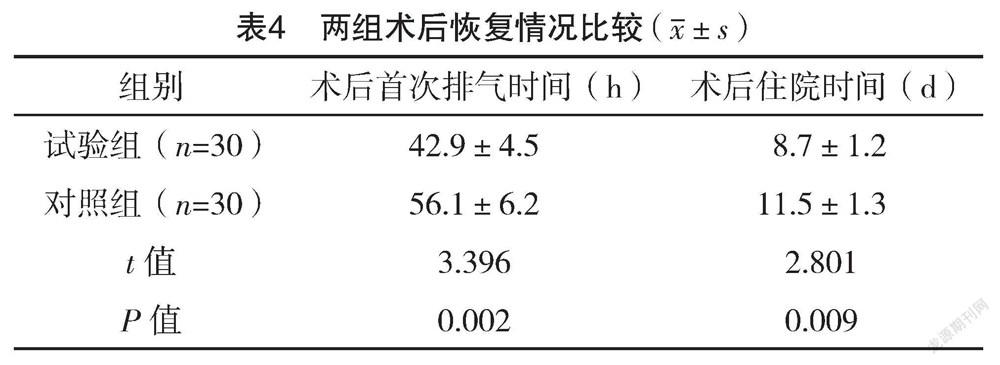
【摘要】 目的:探討腹腔镜直肠癌根治术中保留左结肠动脉(LCA)的安全性和可行性。方法:采用前瞻性随机对照试验,依据随机数字表法,将2018年6月-2020年3月于本院行直肠癌手术患者分为试验组和对照组,每组30例。试验组行保留LCA的直肠癌根治术,对照组行距离IMA根部1 cm的高危结扎。比较两组手术时间、术中出血量、远端和近端肠管切除长度、脾曲游离例数、预防性造口例数、住院时间、吻合口漏、淋巴结清扫总数、253组淋巴结等指标。结果:所有患者手术顺利,且围术期无死亡。两组术中出血量、手术时间、远端肠管切除长度、清除的淋巴结总数目、清除的253组淋巴结数目及253组淋巴结癌转移阳性率比较,差异均无统计学意义(P>0.05)。试验组游离脾曲例数、预防性造口例数、近端肠管切除长度均低于对照组,差异均有统计学意义(P<0.05)。两组均未出现吻合口出血及切口感染。试验组无吻合口漏,对照组4例吻合口漏,两组比较,差异有统计学意义(P<0.05)。试验组术后首次排气时间、术后住院时间均短于对照组,差异均有统计学意义(P<0.05)。结论:腹腔镜下直肠癌根治术中保留LCA在淋巴结清扫根治方面与不保留LCA临床效果相当,并且有利于促进术后肠道功能恢复,降低吻合口漏,安全可行。
【关键词】 直肠肿瘤 左结肠动脉 腹腔镜 淋巴结 吻合口漏
Prospective Randomized Controlled Study of Preserving Left Colonic Artery in Laparoscopic Radical Resection of Rectal Cancer/HU Jun, LUO Junfeng, ZHOU Wenbin, LI Baogen, LYU Yuliang. //Medical Innovation of China, 2021, 18(30) :-116
[Abstract] Objective: To investigate the safety and feasibility of preserving the left colon artery (LCA) during laparoscopic radical resection of rectal cancer. Method: In this prospective randomized controlled trial, patients who underwent rectal cancer surgery in our hospital from June 2018 to March 2020 were divided into experimental group and control group according to random number table method, 30 patients in each group. The experimental group was treated with lCA-preserving radical resection of rectal cancer, while the control group was treated with high-risk ligation 1 cm away from IMA root. The operative time, intraoperative blood loss, distal and proximal bowel resection length, free cases of splenic flexion, preventive stomy cases, length of hospital stay, anastomotic leakage, total number of lymph node dissection and 253 groups of lymph nodes were compared between the two groups. Result: All patients were successfully operated and no perioperative death occurred. There were no significant differences in intraoperative blood loss, operation time, distal bowel resection length, total number of lymph nodes removed, number of lymph nodes removed in 253 groups and positive rate of lymph node metastasis in 253 groups between the two groups (P>0.05). The number of free splenic flexion, the number of preventive colostomy and the length of proximal bowel resection in experimental group were lower than those in control group, the differences were statistically significant (P<0.05). There was no anastomotic bleeding or incision infection in the two groups. There was no anastomotic leakage in the experimental group and 4 cases anastomotic leakage in the control group, the difference between the two groups was statistically significant (P<0.05). The first postoperative exhaust time and postoperative hospitalization time of the experimental group were shorter than those of the control group, the differences were statistically significant (P<0.05). Conclusion: The clinical effect of preserving LCA in laparoscopic radical resection of rectal cancer is similar to that of not preserving LCA in lymph node dissection and radical resection, and it is safe and feasible to promote postoperative intestinal function recovery and reduce anastomotic leakage.
[Key words] Rectal neoplasms Left colic artery Laparoscopy Lymph gland Anastomotic leakage
First-author’s address: Yichun People’s Hospital, Yichun 336000, China
doi:10.3969/j.issn.1674-4985.2021.30.027
直肠癌是我国常见的恶性肿瘤之一,其死亡主要原因是局部复发和远处转移[1]。进展期直肠癌首选的手术方式为腹腔……
登录APP查看全文
猜你喜欢
腹腔镜外科杂志(2022年7期)2022-08-16 04:31:06
临床医药文献杂志(电子版)(2017年11期)2017-05-17 04:48:17
中国内镜杂志(2017年2期)2017-03-20 16:18:12
实用临床医学(2016年8期)2016-06-08 06:10:09
腹腔镜外科杂志(2016年11期)2016-06-01 12:10:09
腹腔镜外科杂志(2016年9期)2016-06-01 12:10:07
中国卫生标准管理(2015年16期)2016-01-20 09:27:19
中国医疗器械杂志(2015年5期)2015-12-31 06:15:30
卫生职业教育(2014年16期)2014-05-16 03:48:30
西南军医(2014年1期)2014-02-03 03:06:16
