颅脑损伤患者早期肠内营养的临床意义
2017-07-13 16:21:21陈毓梅
中外医疗
2017年15期
关键词:炎症因子
陈毓梅
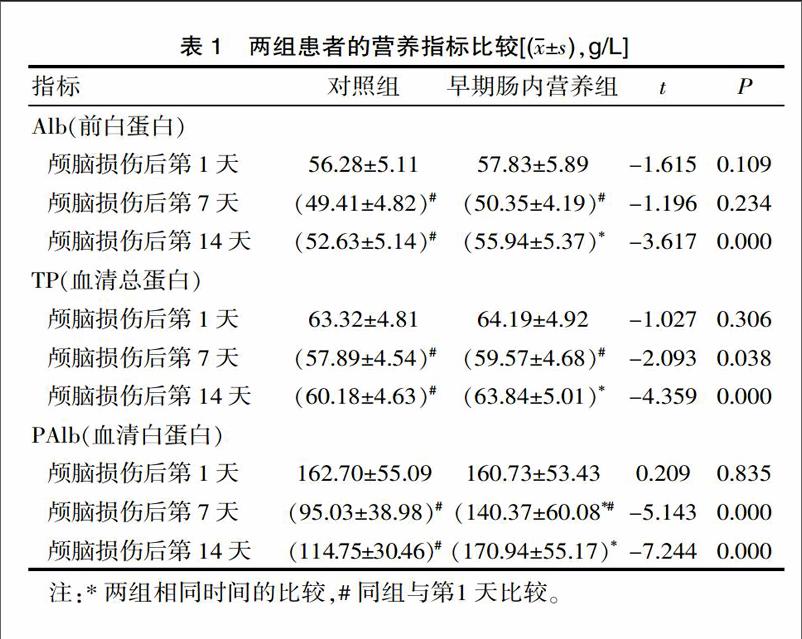
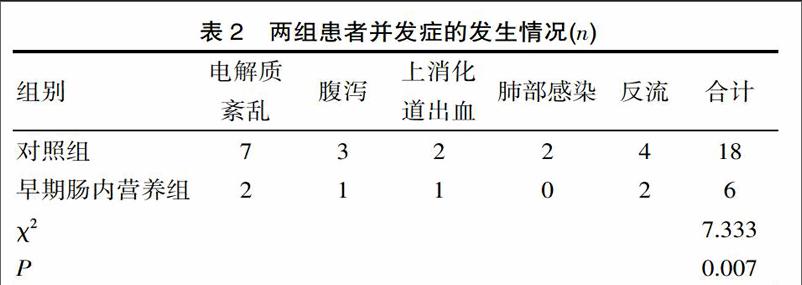
[摘要] 目的 探讨颅脑损伤患者早期肠内营养的临床意义及护理的重要性。方法 方便选取某三甲医院于2014年3月—2016年7月期间,ICU病房收治的颅脑损伤患者132例为研究对象,随机分为早期肠内营养组和对照组各66例。早期肠内营养组于损伤后6~24 h内给予肠内营养治疗,对照组给予肠外营养治疗,观察患者的预后情况。 结果 两组患者在给予营养支持的第7天,前白蛋白、血清白蛋白、血清总蛋白的水平分别为(49.41±4.82)、(57.89±4.54)、(95.03±38.98)g/L以及淋巴细胞计数均显著低于第1天(56.28±5.11)、(63.32±4.81)、(162.70±55.09)g/L(P<0.05),且肠内营养组均高于对照组;早期肠内营养的并发症发生率(9.09%)显著低于对照组(27.27%)(P<0.05)。结论 颅脑损伤患者给予早期肠内营养治疗,可显著改善患者的营养状况,提高患者的免疫功能,且并发症较少,有利于患者的恢复。
[关键词] 颅脑损伤;早期肠内营养;炎症因子
[中图分类号] R473 [文献标识码] A [文章编号] 1674-0742(2017)05(c)-0029-03
[Abstract] Objective To discuss the clinical significance of early enteral nutrition of patients with cerebral injury and importance of nursing. Methods 132 cases of patients with cerebral injury admitted and treated in ICU from March 2014 to July 2016 were convenient selected and randomly divided into two groups with 66 cases in each, the early enteral nutrition group adopted the nutrition treatment after 6 h to 24 h injuries, the control group adopted the parenteral nutrition treatment, and the prognosis of patients was observed. Results The prealbumin, serum albumin, total serum protein and lymphocyte count at 7 d after adopting the nutrition support were obviously lower than that at 1d, [(49.41±4.82),(57.89±4.54),(95.03±38.98)g/L vs(56.28±5.11),(63.32±4.81),(162.70±55.09)g/L],(P<0.05), and these factors in the enteral nutrition group was higher than that in the control group, and the incidence rate of complications in the early enteral nutrition group was obviously lower than that in the control group, (9.09% vs 27.27%)(P<0.05). Conclusion The early enteral nutrition of patients with cerebral injury can obviously improve the nutrition condition of patients and improve the immune function with fewer complications, which is conducive to the recovery of patients.
[Key words] Cerebral injury; Early enteral nutrition; Inflammatory factor
由于顱脑损伤后,机体处于应激状态,患者往往会出现肠胃功能下降、胰岛素分泌不足等一系列的应激反应,此时机体的代谢强度和能量消耗均较大,对机体各系统造成很大的损伤,因此颅脑损伤的致残率和致死率均较高[1],所以在临床治疗时一定要重视营养的重要性[2]。该研究旨在探讨颅脑损伤患者早期肠内营养的临床意义以及护理的重要性,现对2014年3月—2016年7月期间收治的132例患者作为该研究对象,现报道如下。
1 资料与方法
1.1 一般资料
方便选取某三甲医院ICU病房收治的颅脑损伤患者132例为研究对象,其中男性患者93例,女性患者39例。纳入标准:年龄为18~60岁,所有患者均经临床检查以及CT诊断确定为颅脑损伤,并且患者均无其他脏器重大损伤;颅脑损伤后12 h内入院治疗。患者以随机数字表法随机分为早期肠内营养组和对照组,每……
登录APP查看全文
猜你喜欢
中国医学创新(2017年3期)2017-02-22 16:56:52
现代仪器与医疗(2016年6期)2017-01-12 18:26:01
中国当代医药(2016年30期)2017-01-07 00:51:21
中国当代医药(2016年29期)2017-01-03 23:39:42
中国实用医药(2016年30期)2016-12-28 22:58:34
中国实用医药(2016年30期)2016-12-28 11:49:52
中国现代医生(2016年27期)2016-12-21 16:42:20
中国实用医药(2016年20期)2016-08-11 21:28:51
中国现代医生(2015年26期)2016-02-27 12:09:09
山东体育学院学报(2015年3期)2015-08-14 20:33:03